

“Despite all the influencer campaigns, celebrity partnerships, and social media attention, where is the measurable evidence that racing is creating more long-term bettors?”
Mike Repole among plenty of others in this industry keeps echoing a familiar refrain: Dave Portnoy is good for the game.
“Good for the game” is a highly subjective phrase, but in a sport that has spent decades wandering blindly in the marketing wilderness, it has become a lazy catch-all for anyone with a massive following and a microphone. Before we concede the answer is Barstool Sports, we need to strip away the hype, define our terms, and look at the cold, hard numbers. Before we start handing out the label “good for the game,” maybe we ought to decide what success actually looks like.
Because in horse racing, there is a massive, structural difference between lifestyle exposure and sustainable economic growth.
Every year this industry celebrates that roughly twenty five million people watched the Kentucky Derby. Wonderful. Now do the math nobody wants to do. Subtract the people who tuned in for the hats. Subtract the Mint Julep crowd. Subtract the celebrities who showed up because it was the place to be seen and those who watched just to see them. Subtract the casual viewers who watch one race a year the same way they watch the ball drop on New Year’s Eve. What you have left is your actual customer base, and it is a fraction of that number.
The same illusion exists in every sport. The NFL does not count Super Bowl viewers as their core audience. They know millions tune in for the halftime show and the commercials and never watch another game. The audience that matters is the one that comes back on a random Thursday night in November for a game that means nothing to anyone outside of two cities. That is your real customer.
Horse racing never learned that lesson, and no comparison makes it clearer than the poker boom. When poker exploded in the early 2000s, it did not sell itself as a spectacle. It did not chase celebrity sightings or hat contests. It celebrated the gambler as the hero. It made the customer the star. ESPN put players at the final table and the audience understood they were watching skill, nerve, and mastery on display. Millions of people did not just watch poker. They went home and played poker. They funded accounts. They bought books. They studied. They became customers. Horse racing looked at that same era and decided its customer was a fan at a ball game rather than a bettor at a table. That single misreading of its own audience may be the most expensive mistake this sport has ever made.
To understand what Portnoy actually brings to the table, we first have to examine two broken marketing models horse racing currently relies on: the Vanilla Ice Cream Model and the Chaos Agent.
The Vanilla Ice Cream Model: Fluff Without Foundation
A few years back, America’s Best Racing and West Point Thoroughbreds decided to gift a horse share to a content creator named Griffin Johnson. He tweeted his experiences, kept it entirely vanilla, and played the role of the smiling, lucky insider. Johnson is a TikTok star with more than 14 million followers, a founding member of the Sway House, and a co-founder of a venture capital firm. His behind-the-scenes videos with Grade 1 winner Sandman reached more than 200 million people and generated more than 35 million views.
The industry was so desperate for a feel-good story that OwnerView then handed him its 2025 New Owner of the Year award, sponsored by 1/ST Racing.
Read their official rationale carefully. It said Johnson “has had an incredible impact on horse racing through his social media platforms, helping to create new fans, which will ultimately result in new owners.”
Will ultimately result. Future tense. They gave him the award for what they hope might happen someday.
That is a blatant slap in the face to every invested, struggling owner who has poured real money into this game for decades. Meanwhile, the industry still cannot tell you how many new horseplayers Griffin Johnson actually created. How many funded an ADW account. How many are still betting six months later. The answer, to the best of anyone’s knowledge, is somewhere between zero and a rounding error.
It reminds me of the campaign when Gulfstream Park paid TikTok influencer Alix Earle to chronicle her day at the 2024 Pegasus World Cup. Her content reached 6.5 million people in a single day. Her most memorable racing moment? She documented her losing bets. Her biggest takeaway delivered to millions of potential new fans was essentially: I went to the races and lost my money.
No follow-through. No mechanism to convert viewers into customers. No education on how to read a program or place a wager. Just reach, and then silence.
Racing celebrated 6.5 million impressions. Handle kept going down. That is not a marketing campaign. That is wishful thinking with a budget. The racing customer is not NBC. The racing customer is not an influencer. The racing customer is not a celebrity with a gifted horse share. The racing customer is the bettor. Every dollar that enters this sport begins with someone deciding to make a wager. Lose the bettor and eventually everything else follows. Somewhere along the way, racing forgot that.
The Chaos Agent: Enter Dave Portnoy
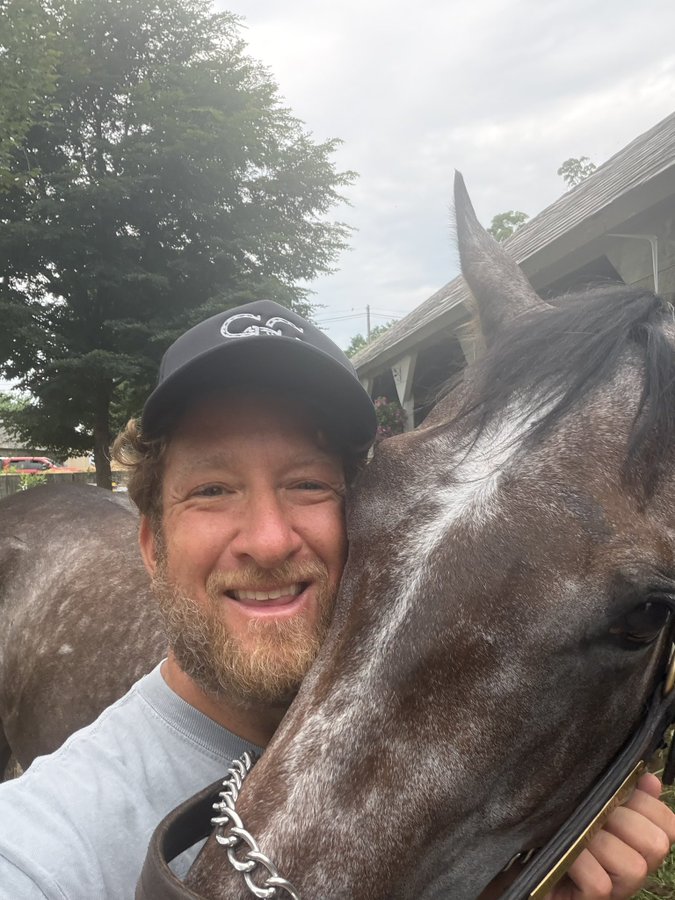
Which brings us back to El Presidente. Portnoy is not vanilla. He puts real skin in the game. He bets. He owns Thoroughbreds with his own money, not a gifted fractional stake engineered for content. He named his stable Go Go Greys and built it around an actual obsession with grey horses, spending over a million guineas at Tattersalls and running horses at Keeneland, Parx, Churchill Downs, and now Saratoga.
On opening day at Saratoga yesterday, his filly Lovely Grey was caught up in a frightening four-horse spill during the Wild Applause. Portnoy did not hide. He did not issue a polished statement through a publicist. He filmed himself back at the barn with the veterinarians and posted that she was okay. In an industry that historically panics and retreats when equine safety becomes the story, that raw transparency was not just refreshing. It was necessary.
He also has a genuine history with this sport. Portnoy traces his love of racing back to trips to Suffolk Downs as a kid. This is not a celebrity endorsement deal. This is someone who actually cares.
But then we get to the other side of the coin. Portnoy regularly takes to his megaphone of 3.7 million followers to launch inaccurate rants about late odds drops and Computer Assisted Wagering. His frustration is legitimate. CAWs are a real problem. Retail bettors are leaving the game. Handle has declined nearly four percent in 2023, another three-plus percent in 2024, and was down again through the first three quarters of 2025. When Portnoy posted that the CAWs had “basically forced him to stop betting horses except the huge days,” he was speaking for tens of thousands of retail players who have no platform and no audience.
The problem is that a complicated structural issue keeps becoming a two-hundred-and-eighty-character indictment. He called the current system “actually criminal.” He told millions the game was rigged against them. Then, later and more quietly, he clarified his actual position: he did not want CAWs eliminated, he wanted them cut off at five minutes to post. That is a reasonable position. It is actually the position serious industry voices have advocated for. But millions of people never hear the clarification. They hear the headline.
The data tells a more complicated story than Portnoy’s posts allow for. During a year-long study at Santa Anita, seventy percent of the late money in wagering pools came from non-CAW players. In fifteen percent of races during that same period, the winning horse’s price dropped ten percent or more in the final thirty seconds with virtually no CAW money in the pool at all. The problem is real. The mechanics are not what he described.
There is a meaningful difference between exposing a problem and accurately defining it. There is an even bigger difference between defining a problem and solving one.
When someone with Portnoy’s reach tells millions of people the game is hopelessly corrupt before they ever make a wager, perception becomes reality. That influence carries responsibility. Not because he should be silenced. Because precision matters.
The Verdict: What Is the Handle Worth?
So is Dave Portnoy good for the game?
He is better for the game than Griffin Johnson and Alix Earle combined, because at least he is real. He has genuine history with this sport. He spends his own money. He feels what retail bettors feel because he is one. He was at Saratoga yesterday when his horse went down and he handled it with more transparency than most industry executives would have managed.
But good for the game, by any definition that actually means something, requires more than authenticity. It requires the sport meeting him halfway. It requires handle going up, not down. It requires new bettors opening accounts, not just watching viral videos. It requires the industry to stop confusing reach with results.
If “good for the game” means getting eyeballs on a screen and making Saratoga look like a party, Portnoy delivers.
If it means protecting the integrity of the betting pools, driving handle, educating the public, and building the sophisticated horseplayers this sport needs to survive the next generation, the jury is still out.
Dave Portnoy is not the problem. He is the mirror. And racing does not always like what it sees.
Attention is rented. Customers are earned. Racing has become remarkably good at measuring applause and remarkably bad at measuring customers.
The Invitation
Mike Repole says you’re good for the game, @stoolpresidente. The industry celebrates impressions while handle continues to fight headwinds. Those are not necessarily the same thing.
You’ve got the biggest microphone in racing right now. Your horse went down on a track yesterday and you showed the world exactly who you are. You have been in this sport long enough to know what it can be. You spend real money. You feel what every retail bettor feels when the tote board moves against them in the final seconds.
Let’s sit down and answer the question nobody in this industry seems willing to ask.
What does “good for the game” actually mean?
No screaming. No cheap shots. No agenda. Just two people who care deeply about horse racing having the conversation this sport has been avoiding for years. Maybe a little screaming.
Related Coverage: When Handle Becomes DestructiveWhat the Belmont Didn’t Tell You, But We WillWhen You Give Horseplayers a Fair Shake, They Bet. Period.The Leak, the Noise, and the Number Nobody Wants to Say Out LoudUpon Further Review, This Story Is Much Bigger Than a ScreenshotThe Jockey Club Finally Speaks. They Just Didn’t Answer Anything.A Discrepancy That Doesn’t Hold Up
If he’s a good hitter why doesn’t he hit good?