
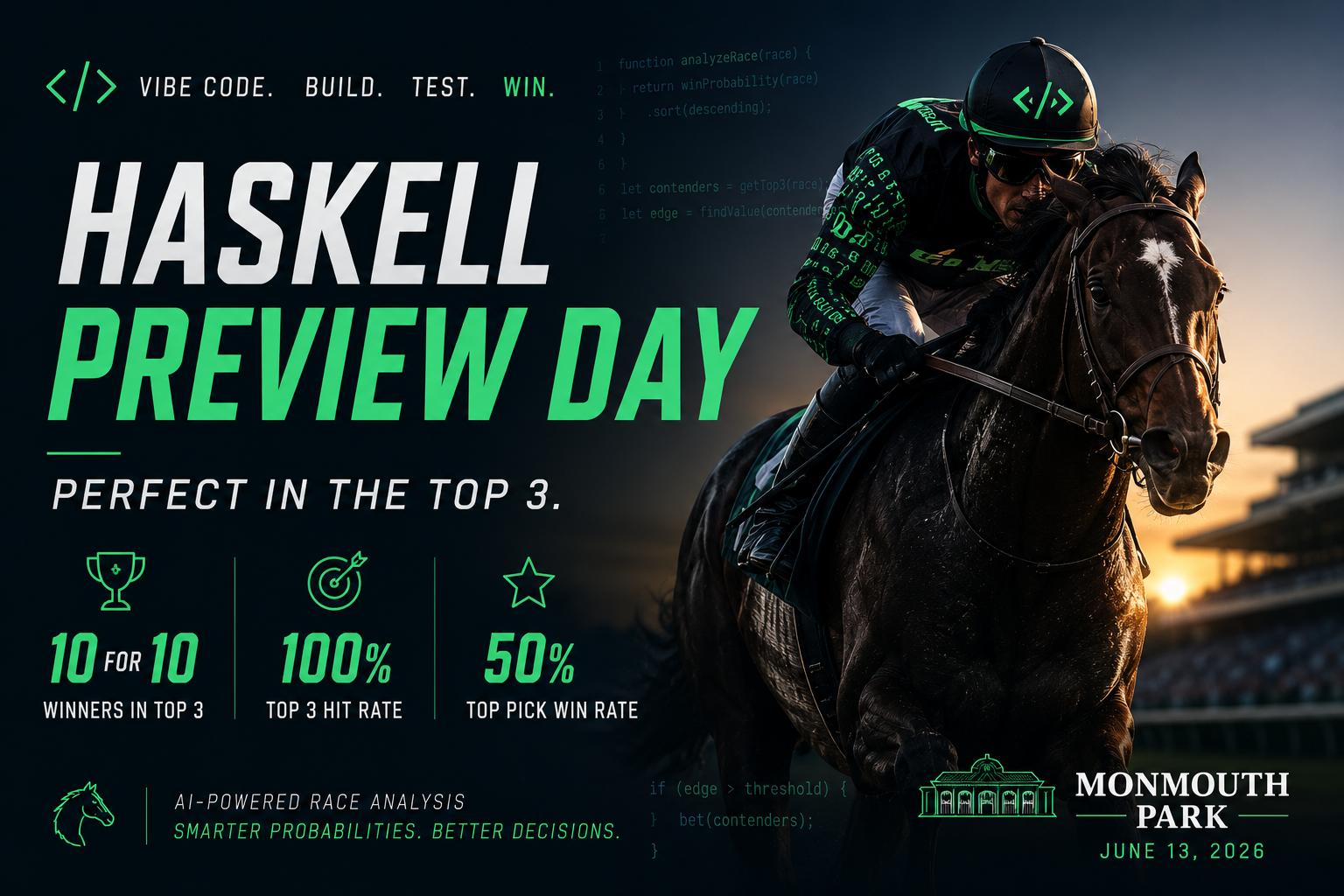

Highlighting success from top to bottom at Haskell Preview Day at Monmouth Park
James Gazzale
One of the fun parts about building a horse racing betting app is that every racing card becomes a test.
Some days you’re looking for signs of progress.
Other days you’re looking for bugs.
And occasionally, you get a day that makes you stop, stare at the results, and wonder if all those late nights spent tweaking probabilities and pace projections might actually be paying off.
Saturday’s Haskell Preview Day at Monmouth Park felt like one of those days.
For the past several months, I’ve been vibe coding a horse racing betting app designed to evaluate races through win probabilities, pace scenarios, class, form, and value. The goal has never been to predict every winner. Horse racing is too difficult, and too humbling, for that.
Instead, the objective has been to identify the most likely contenders in each race and create a framework that helps bettors focus on the horses that matter most.
On one of Monmouth Park’s biggest cards of the season, the app delivered its strongest single-day performance yet.
A Perfect Day in the Top Three
Haskell Preview Day featured a 10-race card highlighted by four stakes races:
· Grade 3 Eatontown Stakes
· Pegasus Stakes
· Monmouth Stakes
· Grade 3 Salvator Mile Stakes
These weren’t soft spots.
These were the races horseplayers across the country were studying in preparation for next month’s Haskell Stakes Day and the heart of the summer racing season.
When the final race was official, the app had accomplished something remarkable.
All 10 winners appeared within the app’s top three selections based on projected win probability.
That’s 10-for-10.
Or if you prefer percentages, a 100% Top 3 hit rate.
In horse racing, where chaos is always lurking around the corner and even the best handicappers spend plenty of time second-guessing themselves, that’s a difficult number to ignore.
The Top Picks Came Through
Just as impressive was the performance of the app’s highest-rated selections.
Five of the 10 races were won by the horse ranked first in projected win probability.
That’s a 50% win rate from the app’s top selection.
To put that into perspective, horseplayers are constantly searching for small edges in this game. Finding a profitable angle often comes down to a few percentage points.
A single-selection strike rate of 50% over an entire card is the kind of performance that gets your attention.
The five winning top selections were:
| Race | Horse | Win Payoff |
| Race 1 | Fidelightcayut | $3.00 |
| Race 2 | Twelve Treasures | $9.40 |
| Race 3 | She’s a Gamer | $3.40 |
| Race 6 | Program Trading | $2.60 |
| Race 8 | Enjoying | $2.60 |
Among the five winners, Twelve Treasures stood out as the highest-paying top selection of the day, returning $9.40 to win. While several of the successful top picks were logical contenders, Twelve Treasures demonstrated an important principle behind the project: probability-based handicapping isn’t simply about identifying favorites. It’s about identifying horses whose chances of winning may be greater than what the public is willing to recognize.
The Stakes Races Told the Story
Perhaps the most encouraging aspect of the day was how the app handled the featured races. Every stakes winner appeared within the app’s top three win-probability selections.
For a project that’s still evolving, that’s exactly the type of validation you hope to see.
Stakes races tend to attract deeper fields, stronger horses, and more efficient betting markets. They’re often more difficult to solve than the average overnight race.
Yet the app consistently identified the horses that would ultimately have the biggest impact on the outcome.
More Than Picking Winners
One thing I’ve learned since starting this project is that successful handicapping isn’t always about selecting the winner.
It’s about identifying the right horses. There’s a difference.
A bettor who consistently narrows a race to the correct group of contenders puts themselves in position to capitalize on exactas, trifectas, multi-race wagers, and value opportunities that aren’t available when you’re chasing a single horse.
That’s why the 100% Top 3 statistic stands out more than anything else from Saturday.
The app wasn’t perfect.
It didn’t pick every winner on top.
But it identified every winner as a legitimate contender before the gates opened.
That’s exactly what it was designed to do.
Building Momentum
Last weekend, the app produced encouraging results during the Belmont Stakes Racing Festival, one of the toughest handicapping challenges of the year.
Saturday at Monmouth Park felt like a continuation of that progress.
Not because it proved the app is finished. Far from it.
The project is still evolving, still learning, and still undergoing constant refinement.
But every now and then you have a day where the probabilities align with the outcomes, the pace projections unfold as expected, and the horses you’ve identified keep showing up in the winner’s circle.
Haskell Preview Day was one of those days.
The Bottom Line
The goal of this project has never been to build a machine that predicts every winner.
If horse racing has taught us anything, it’s that certainty doesn’t exist.
The goal is to build a tool that consistently identifies the horses with the best chances to win and the best opportunities to outperform expectations.
On Haskell Preview Day at Monmouth Park, the results were hard to argue with.
Ten races.
Ten winners ranked within the top three win-probability selections.
Five winning top picks.
A 100% Top 3 hit rate.
A 50% top-pick strike rate.
And successful identification of every stakes race winner on the card.
For a project that started as a simple vibe-coding experiment back in January, that’s a pretty good day at the races.
More importantly, it’s another encouraging data point in a testing process that has now evaluated nearly 200 races. One day doesn’t prove anything in horse racing, but when a project consistently identifies contenders and occasionally produces a performance like Haskell Preview Day, it’s hard not to be excited about what comes next.