

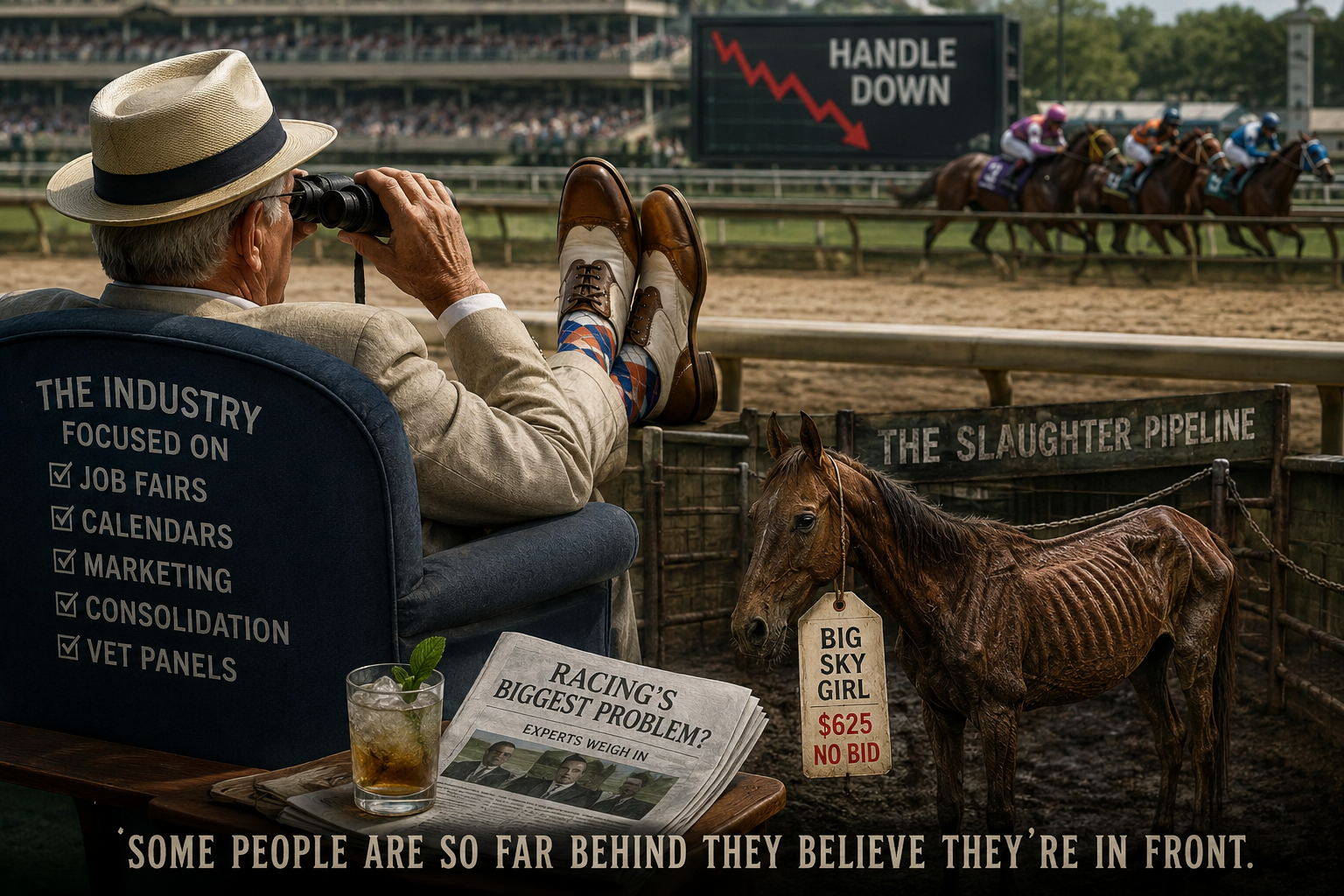

Four Installments In, A Pattern Has Emerged. It Is Not A Good One.
I said I rarely read racing articles. I meant it. When the TDN’s new series, Racing’s Biggest Problem, And The Solution, crossed my eyes last Wednesday, I read it anyway. David Ingordo’s installment bothered me enough that I felt compelled to respond. I wrote that response and published it here at Past The Wire. I thought I was done. I assumed it was a one off, one man’s blind spot, one missed opportunity, one article.
Then the algorithm apparently decided I was now a reader of this series. Three more installments found their way in front of me. I did not go looking for them. They came to me. And what I found across those three additional entries did not reassure me that the Ingordo piece was an isolated case.
This is not one person’s blind spot. This is an industry’s.
The Scorecard
Let me be precise, because precision matters here. TDN has now published four installments of a series explicitly titled Racing’s Biggest Problem. The title is not One Of Racing’s Many Concerns. It is not My Biggest Concern. It is not An Operational Frustration I’d Like To See Addressed. It is Racing’s Biggest Problem.
Those words carry weight. They imply a hierarchy. They imply that the person answering has surveyed the full landscape of what is threatening this sport and landed on the one thing that sits above everything else. That is the standard the series set for itself.
Here is what four installments have produced.
Conrad Bandoroff, Vice President, Denali Stud, June 23. Regulatory veterinary scratches. His complaint, a legitimate operational grievance, is that sound horses are being scratched on race day without adequate recourse for trainers and owners. He wants a panel review process. This is a real frustration shared by many in the barn. It is not racing’s biggest problem.
David Ingordo, bloodstock agent and HISA ADMC committee member, June 24. Workforce development. Where will the next trainers, veterinarians, and farriers come from? Job fairs. Mentorship programs. Scholarships. Todd Pletcher going back to Texas. I have already written at length about why this answer inverts the actual problem. The pipeline is thin because the destination is in question, not the other way around.
Jacob West, Stallion and Season Manager Claiborne Farm, June 25. No national racing calendar. His solution is a Super Saturday concept, marquee race days on the first Saturday of every month structured like mini Breeders’ Cup events. A marketing idea. A scheduling idea. Not racing’s biggest problem.
Tony Lacy, Keeneland Vice President of Sales, June 26. Industry fragmentation. Racetracks are not singing off the same hymn sheet. We need consolidation, a collective approach, everyone working together. He briefly mentions the customer, saying racing needs to let people feel the adrenaline, but frames it as a marketing and education problem. He describes the industry’s job as being “almost like drug dealers” getting people hooked on the product. That is a colorful way to avoid saying the product itself is under structural threat.
Four installments. Zero mentions of handle decline. Zero mentions of CAW. Zero mentions of the slaughter pipeline. Zero mentions of the retail bettor as a crisis. Zero mentions of governance. Not one.
What Was Never Said
Across four installments, four industry figures, and four opportunities to say something that might actually matter, here is what did not appear once.
Handle is in structural decline. The sport’s wagering base, the economic engine that funds every purse, every owner’s investment, every trainer’s barn, every sales ring result, is shrinking. The retail bettor, the person who built this sport from the grandstand up, is being systematically extracted from the pools by computer assisted wagering operations whose technological advantage over the individual player is not a gap but a chasm. PTW has covered this in depth. NYRA CEO David O’Rourke spoke about it on the record during Belmont week. The data exists. The pattern is documented. It did not appear in any of these four answers.
The aftercare and slaughter pipeline crisis is an open moral wound. Former racehorses are ending up in kill pens. Millionaires and billionaires who profited from these animals develop what I have previously called short arm syndrome when it is time to fund their retirement. This is the story that reaches people outside racing’s walls. This is what a young person sees when they search for horse racing online. It did not appear in any of these four answers.
Governance is a persistent, documented problem. The institutions that hold authority over this sport’s future operate with limited transparency and enormous deference to elite financial interests. PTW has covered this extensively through Form 990 filings, through the Empty Chairs series on The Jockey Club, through the architecture of how decisions get made and whose voices are amplified and whose are not. It did not appear in any of these four answers.
HISA’s enforcement record remains contested and in many cases unresolved. The Paco Lopez situation. The Felissa Dunn case that collapsed. The ongoing frustration among horsemen who feel the regulatory framework was built for appearances more than outcomes. It did not appear in any of these four answers.
The customer, the horseplayer, the retail bettor, the person whose wager funds the entire ecosystem, was mentioned once, briefly, as a marketing target. Not as a constituency in crisis. Not as someone the sport has an obligation to protect. As a potential convert to be acquired. That is not the same thing, and confusing the two is part of how we got here.
CAW handle dependence.
Top jockeys engaged in cockfighting and illegal gambling.
The Pattern Is The Problem
I want to be careful here because I genuinely respect the right of others to hold opinions different from mine. Bandoroff, West, and Lacy are serious people with real experience in the sport. Their frustrations are real. Their ideas are not without merit. I am not saying any of them are wrong about everything they said.
What I am saying is this. When you ask four consecutive industry participants to name racing’s single biggest problem, and all four land on operational inconveniences and marketing deficits while collectively ignoring every structural threat the sport is facing, that is not a coincidence. That is a worldview.
And it is a worldview shaped almost entirely by where these people sit in the sport’s hierarchy.
All four are connected to the sales and ownership axis of racing, the part of the sport where elite prices are still being achieved, where the best horses are still attracting serious investment, where the daily reality of a contracting handle and a shrinking retail base is felt, if at all, as a distant abstraction. From that vantage point, the sport’s problems look like scheduling problems, marketing problems, calendar problems, and staffing problems. Problems that can be solved with enough organization and goodwill.
From the vantage point of someone who has spent fifty years in the betting trenches, who has watched the pools change, watched the retail player get squeezed, watched the sport’s moral credibility erode with every horse that ends up somewhere it should never be, the problems look very different. They look structural. They look urgent. They look like the kind of problems that do not yield to job fairs and Super Saturdays.
The data is there for anyone willing to look at it. Some people are so far behind they believe they are in front.
A Word To TDN
The Thoroughbred Daily News is a trade publication I respect. It has broken important stories. It covers the sport with consistency. I have no interest in diminishing that.
But a trade publication carries a responsibility that goes beyond platform. In a sport facing a genuine structural crisis, declining handle, a contested regulatory environment, aftercare failures that reach a national audience, and governance questions that have gone unanswered for years, publishing a series titled Racing’s Biggest Problem and filling it with operational complaints and marketing suggestions is not neutral. It normalizes the avoidance of the real conversation. It tells the sport’s power structure that the questions being asked are the comfortable ones. It signals to the people who most need to be challenged that they will not be challenged here.
If TDN intends to continue this series, I would ask them to consider two things.
First, change the name. Call it My Biggest Concern or What I’d Fix Tomorrow, something that accurately reflects the scope of what is actually being discussed. Racing’s Biggest Problem is a standard these installments have not met and, based on the voices being selected, may not be designed to meet.
Second, find different voices. This sport has people in it who have looked at the data, felt the contraction personally, watched the retail base erode in real time, and are willing to say the difficult thing on the record. They exist. They are not hard to find. They simply tend not to be the first calls made by publications whose coverage naturally reflects the perspectives of the ownership and sales establishment. That is understandable. It is also exactly the kind of structural pressure that shapes coverage in ways the sport cannot afford right now.
Racing’s biggest problem is not that we lack a national racing calendar. It is not that regulatory veterinarians have too much authority on race day. It is not that the pipeline of future trainers is thin.
Those are real issues. They are downstream issues.
The upstream issues, the ones that determine whether any of those downstream problems ever get solved, are the ones that did not appear once across four installments of a series that promised to name them.
Three articles. Three different subjects. One common denominator. The industry’s greatest talent is not solving problems. It is redefining them until they become comfortable enough to ignore.
That silence is not accidental. It is not harmless. For the horses, and for the people in this sport who see what is actually happening and are fighting to change it, that silence is its own kind of answer.
And it is a sad one.
Hello? Is there anybody in there?