
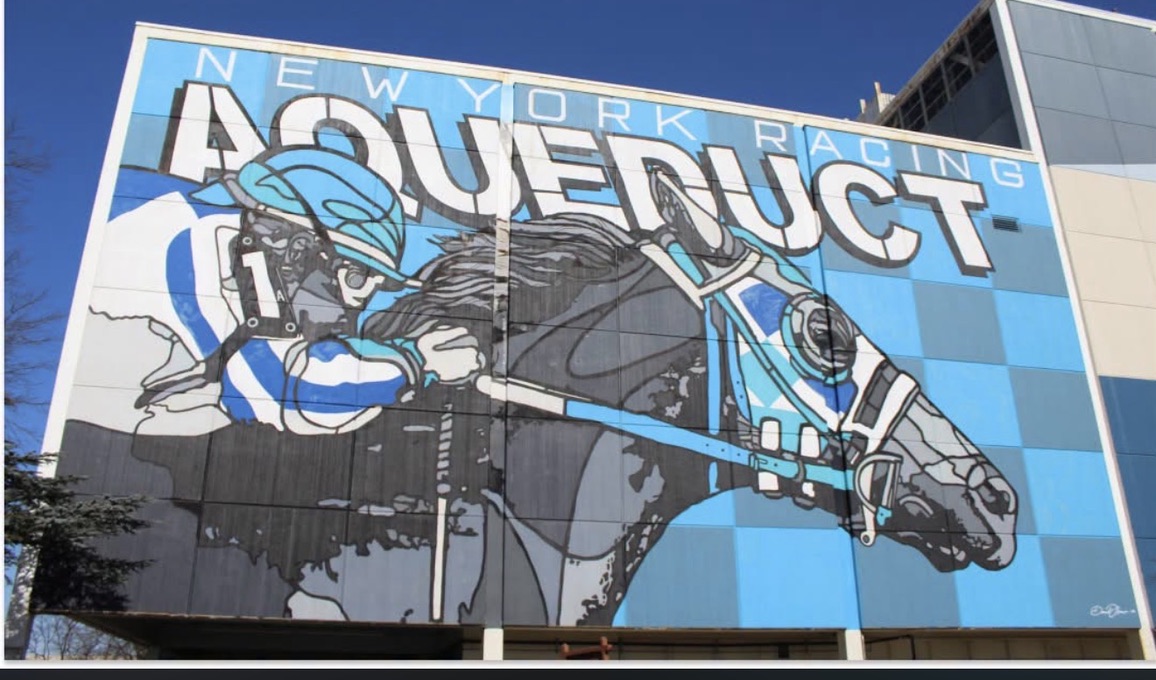

Farewell to the Big A, NYRA Photo
Ed Cofino
There is a certain kind of place that becomes more than what it was built to be. A place where strangers became friends, where memories were made during the spring, fall, and cold winter afternoons. Where dads would take their young sons, and where other young boys would skip school for the rush of the action, and where owners, trainers and jockeys would go to for great racing. For 132 years, Aqueduct Racetrack was that place for New York City and New York Racing. It was the place to be.
Today, June 28, 2026, Aqueduct runs its last race. The final entry on today’s program is fittingly titled “It Was a Good Run.” YES IT WAS!!!
From Farmland to Legend
Aqueduct first opened on September 27, 1894, on former farmland in Queens that had once been part of Brooklyn’s water system giving the track its famous name. An Aqueduct is, an artificial conduit built to transport / move water from a source to cities, towns and agricultural areas. Originally they relied primarily on the force of gravity to move water. Modern aqueducts use pumping stations and pressure to move water to farther distances. I have been fortunate to see the Aqueduct in Segovia, Spain, and it was beautiful and left an impact.
I’ve spoken with so many people over the past year who have said the same about Aqueduct Racetrack.
The early days were modest, with the original grandstand only seating roughly 2,000 people, and a farm still existed inside the infield when racing began. It initially measured only six furlongs, and because of that, Aqueduct wasn’t even recognized by The Jockey Club as an official racecourse because it failed to meet the organization’s one-mile minimum. They called it the “outlaw track,” somewhat appropriate for the burrow it was in, and the stories that have been told. That said, Aqueducts real story was only beginning. And even though the locals loved to refer to it as the “Outlaw Track,” that phrase would quickly be replaced by words like “Beauty, Splendor, the Cathedral of Racing, etc…
Aqueduct Racetrack was completely rebuilt between 1955 and 1959. The cost back then was $34.5 million, which made it not only one of the most expensive of that time, but also it was the world’s largest sports venue in terms of acreage ever
On September 14, 1959, the new Aqueduct reopened to 42,000+ fans. New York City and New York racing was buzzing with hope, with New York racing entering a new era, and Aqueduct would be its Queen.
The Horses That Made History
If you want to understand what the Big A meant to the sport, and to the city, all you have to do is look at the names that raced there. Man o’ War, Sea Biscuit. Riva Ridge, Secretariat, Seattle Slew, Kelso, Forego, Dr. Fager, Damscus, Sword Dancer, Cigar, Easy Goer, Smarty Jones and so many others all built their legends at Aqueduct.
Man o’ War won the 1920 Dwyer Stakes there. Kelso, who claimed five consecutive Horse of the Year titles in the 1960s, called Aqueduct home for many dominant performances. Seattle Slew won the 1977 Wood Memorial at Aqueduct on his way to sweeping the Triple Crown. Dr. Fager broke his maiden in his first career start at Aqueduct by 7 widening lengths. And Cigar started his record breaking 16 race win streak at The Big A, including winning the Grade 1 NYRA Mile, later being renamed to honor the Hall of Fame Champion, as the Cigar Mile in 1994.
And then there was Secretariat. He began his legendary career at Aqueduct and ended it there too. On November 6, 1973, Secretariat was retired at the track. Jockey Ron Turcotte was on his back where he blonged, and Ron paraded Big Red in front of the Clubhouse and Grandstand before 30,000 fans, celebrating (as many will tell you) the greatest racehorse of all time There was not a dry eye in Queens that day, and most of the racing world shed both tears of joy and sorrow.
Moments That Stopped Time
Every great racetrack has moments that not only fans never forget, but the ons they argue about for decades. Aqueduct made plenty of those memories.
On June 10, 1944, one of the most amazing finishes to a horse race, the only triple dead heat in stakes racing history took place when Brownie, Bossuet, and Wait a Bit hit the wire together in the Carter Handicap. Racing officials stared at the photo for a long time that day. There was nothing to see. Three horses not separated, all three noses hit the wire at the exact same time. The big winner? Horseracing history.
From 1963 through 1967, Aqueduct hosted the Belmont Stakes while Belmont Park underwent renovation. The Big A rose to the moment, as it always did. Similar to how Saratoga just did in hosting the Belmont Stakes and the Belmont Racing Festival these past 3 years.
Aquesduct didn’t just have horseracing, among other events, one of the most important happened in October 1995. A crowd of 75,000 gathered at Aqueduct to celebrate Mass with Pope John Paul II, a moment that had nothing to do with horse racing and everything to do with what the track meant to this city. It was a gathering place. A community. A home.
While Saratoga offered tradition and Belmont showcased grandeur, Aqueduct became the place where serious racing fans gathered throughout the winter and early spring, often enduring snow, wind, and freezing temperatures simply to watch great horses compete. That was the Big A. No frills. No apologies. Just racing.
The Final Furlong
The end of the Big A comes amid increased competition for gambling dollars. The newly rebuilt Belmont Park, set to reopen in September 2026 after a roughly $550 million renovation, will serve as NYRA’s lone downstate track going forward. New York State is now proposing housing, retail, community facilities, and open space for the more than 100 acres in Queens. Progress, they call it.
At about 5:50 p.m. ET today, Sunday June 28, 2026, the sounds of hooves striking the ground as the horse’s race, the crowd cheering their horses, families gathering on a weekend. At Aqueduct Racetrack, that will forever be silenced, and forever missed.
But here is what they cannot take: the memories, the champions, the cold winter mornings and the hot summer afternoons. The people who gave their lives to this place, the tellers, the grooms, the clockers, the bettors, the backstretch workers, and the jockeys who rode through rain and snow just for the chance to do what they love. Ride horses at the Big A
So raise a glass to Aqueduct. To the Wood Memorial and the Cigar Mile. To Man o’ War, Seabiscuit, Secretariat, Cigar, Easy Goer, Smart Jones and all the others. To the 75,000 who stood in Queens and listened to a Pope. To every longshot that paid and every favorite that broke hearts.
It was a good run.
Past The Wire — Where the Winners Play.
Eduardo (Eddie C) Cofino