


There’s an old line—one I’ve learned to trust more than anything anyone says publicly:
Watch what they do, not what they say.
Because what they do is where the truth lives. Recently, on a Past the Wire show, I put up a graphic pulled directly from the “About Us” page of The Jockey Club. Not interpretation. Not paraphrasing. Their own words.
Words that defined who they are, what they do, and—most importantly—what they claim responsibility for.
It read, in part:
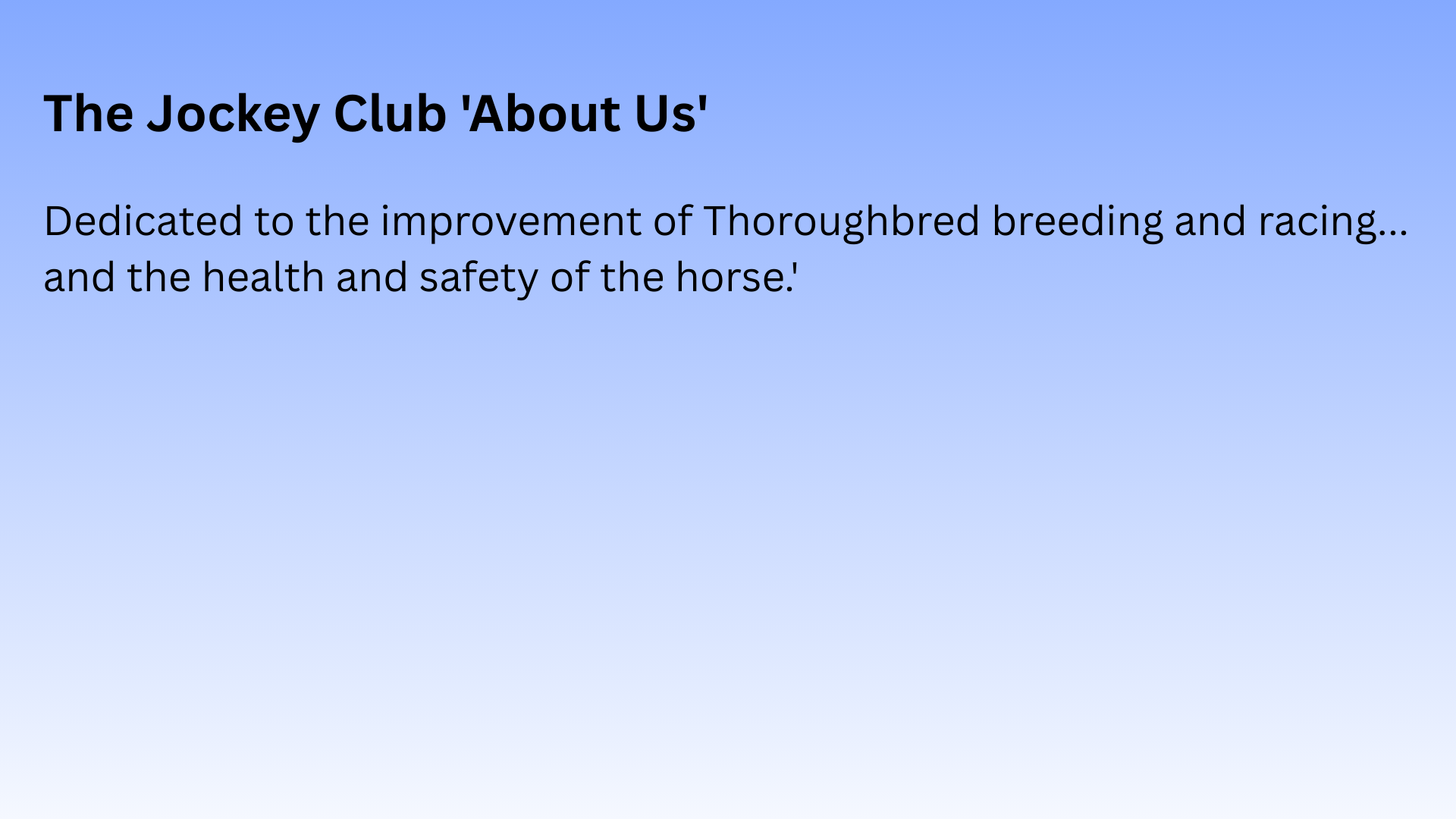
Clear. Direct. Self-defined. Not my standard. Theirs.
Then Something Interesting Happened
After that show aired, the language changed. Not tweaked. Not polished. Changed. The page was rewritten. The framing shifted. The tone softened. And notably, the clarity around responsibility—the kind that invites accountability—was no longer as explicit as it once was. No announcement. No explanation. Just… different.
It now reads in part:
The Jockey Club has pursued its mission as an organization dedicated to the improvement of Thoroughbred breeding and racing, and in the course of the ensuing 125-plus years it has earned widespread recognition as an industry leader for its active involvement in vital industry issues as well as its proficiency as a technology solutions and information provider.
Please take note that “health and safety of the horse” is deleted language, we will come back to that at a later time.
Now, maybe that’s coincidence. Maybe it’s just timing. But in this sport, where every word is weighed, every statement is vetted, and every public-facing message is intentional, coincidences like that tend to belong more in romance novels than in boardrooms.
So Let’s Ask the Only Question That Matters
What changed? Was it the mission? Or the willingness to be held to it? Because the original language didn’t come from critics. It didn’t come from Past the Wire. It came from The Jockey Club itself—an organization that has long positioned itself as a steward of the sport, a leader in its direction, and a central voice in its future.
That’s not something we assigned to them. That’s something they claimed.
This Is Where It Gets Important
Past the Wire didn’t create a standard and demand they meet it. We simply held them to the one they wrote. And when that standard was put under a light—clearly, publicly, and without apology—the record changed. Not the past. Not the reality. Just the wording.
And That Matters More Than They’d Like
Because when language that defines responsibility disappears, it raises a simple and unavoidable question: Is the goal no longer the same…Or is the accountability no longer comfortable? This isn’t about semantics. It’s about structure. It’s about who leads, who answers, and who ultimately stands behind the state of the game.
For years, the industry has operated in a space where roles are implied, influence is exercised quietly, and accountability is often just out of reach—acknowledged in theory, but rarely in practice. That only works as long as nobody presses.
We Pressed
And we’ll keep pressing. Not for confrontation. Not for noise. But for clarity. Because if an organization defines itself as a leader in “vital industry issues,” then it doesn’t get to step back from that definition when those issues are brought into focus.You don’t get to write the mission……and then rewrite it when it becomes inconvenient.
The Record Is Still the Record
The words may be gone from the page. But they’re not gone from the record. And they’re certainly not gone from the conversation. As for what this means going forward—that’s up to them. But one thing is certain:
When the language changes without explanation, people notice. Even if that wasn’t the plan.
“The greatest trick the devil ever pulled was convincing the world he didn’t exist.” — The Usual Suspects
In this case, it might be convincing the industry they never said what they clearly did.
Empty Chairs, Catch the Whole Episode: