

Another day, another “nothing to see here” moment in horse racing.
That’s how this will be treated in certain corners of the sport. A media shift. A business decision. Changing times. Nothing to worry about.
Except that’s not what this is.
FanDuel just told you everything you need to know. The question is whether anyone in a position of authority is paying attention — because the people on social media certainly were.
The Announcement
FanDuel is phasing out its television operation over the next 20 months. Not tweaking it. Not rebranding it. Phasing it out. Over 100 jobs eliminated. Studio production winding down. Live programming scaled back. What remains is essentially a stripped-down racing feed — the operational minimum required to keep the wagering product running.
The end of FanDuel TV as a meaningful racing platform.
The initial reaction from industry leadership? Silence. No statement. No plan. No acknowledgment of what this actually means.
The reaction from everywhere else? Immediate and unambiguous.
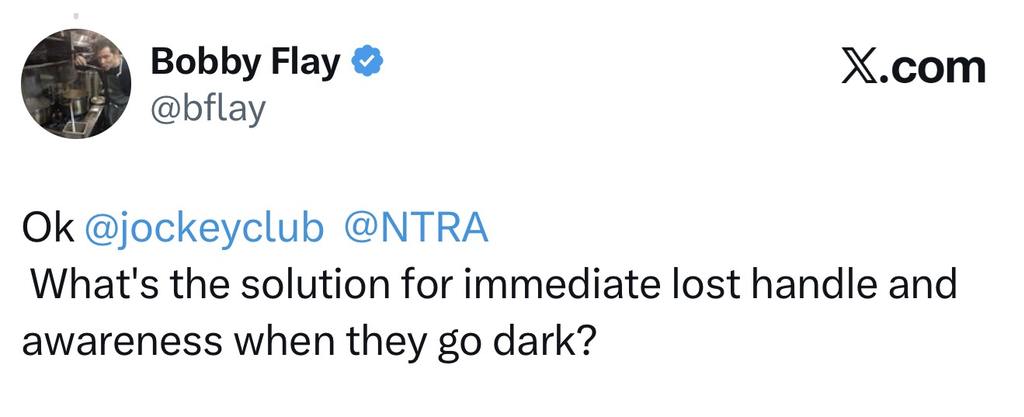
Social media erupted within hours. Bettors, horsemen, fans, and industry observers said plainly what the institutions wouldn’t — that this was a long time coming, that the warning signs had been ignored, and that nobody at the top of the sport seemed to have a plan. Even celebrity chef and racehorse owner Bobby Flay weighed in, directing his question straight at The Jockey Club and the NTRA: “What’s the solution for immediate lost handle and awareness when they go dark?”
It’s a fair question. The silence in response made it louder.
This Wasn’t a Cost Cut. It Was a Decision.
FanDuel is not a company in distress. They are one of the most powerful betting operators in the world, generating substantial revenue across sports wagering, iGaming, and emerging betting verticals. When a company of that scale pulls back, it’s not because they have to. It’s because they’ve decided something no longer deserves the investment.
Horse racing didn’t make the cut — not as a media property, not as a growth engine, not as something worth building around.
That’s not a budget problem. That’s a belief.
From Centerpiece to Side Dish
FanDuel isn’t exiting racing entirely. They’re keeping the wagering. They’re keeping the signal. They’re just removing the commitment — no meaningful studio presence, no investment in storytelling, no infrastructure for new fans. Racing goes from a product to showcase to a product to service.
That’s a demotion. And it’s the kind of demotion you don’t recover from without a deliberate response.
FanDuel TV wasn’t simply a channel. It was a front door — reaching roughly 30 million homes, providing exposure to casual fans, offering a bridge to new bettors. Racing is now a tab on an app. A tile on a screen. Something you find if you already know where to look.
That’s not growth. That’s containment.
Some of you will remember when we had TVG and HRTV running simultaneously.
The Cord-Cutting Deflection
You’ll hear the expected explanations. Linear TV is dying. Everything is shifting to digital. Both things are true, and both things are beside the point.
Other sports aren’t retreating in the face of that shift — they’re building. Direct-to-consumer platforms. League-owned media channels. Aggressive content strategies that meet audiences where they are. Racing remains fragmented, dependent, and still waiting for someone else to carry the water.
FanDuel didn’t kill racing TV. They just stopped propping it up.
Follow the Money
FanDuel is doubling down on what works. Meanwhile, racing remains structurally outdated, economically top-heavy, and increasingly difficult for the everyday bettor to navigate — CAW distortions in the pools, governance that protects itself before the game, and media that has too often played along.
Now add this: even the companies benefiting from the current system are quietly reallocating away from it.
Think about that.
This isn’t happening in isolation. It’s part of a pattern — bettors squeezed, owners leaving, trainers running, field sizes shrinking, aftercare resources stretched, lawsuits accumulating, and remaining confidence eroding. And now the largest betting platform in the sport is scaling back its commitment to showcasing it.
Not exiting. Just stepping back. That’s how it starts.
The Quiet Exit
I tried to see this as an opportunistic positive. I wanted to. Maybe someone new launches a better network. Perhaps an existing powerhouse picks things up and expands it. I couldn’t get there. I’d still like to.
FanDuel didn’t slam the door. They didn’t issue a dramatic statement. They didn’t have to. They made a business decision — and companies making decisions from a position of strength rarely get those wrong.
Bobby Flay’s question, fired off publicly at the sport’s two most prominent governance bodies, is still waiting for an answer. So is the larger one underneath it:
When the biggest betting company in the game decides horse racing isn’t worth building around anymore, the question isn’t what FanDuel is doing.
It’s why the people running this sport still don’t seem to see it.
This wasn’t a media move. It was a vote of confidence. And right now, the smart money is voting with its feet.
Get your reservation for our annual Kentucky Derby seminar now! Details Here
Photo: Bobby Flay X feed
Goodbye: