
 Brought to you by AmWager
Decoupling and Its Impact on Florida Horse Racing: Who Wins, Who Loses
The Handicapper’s Perspective:
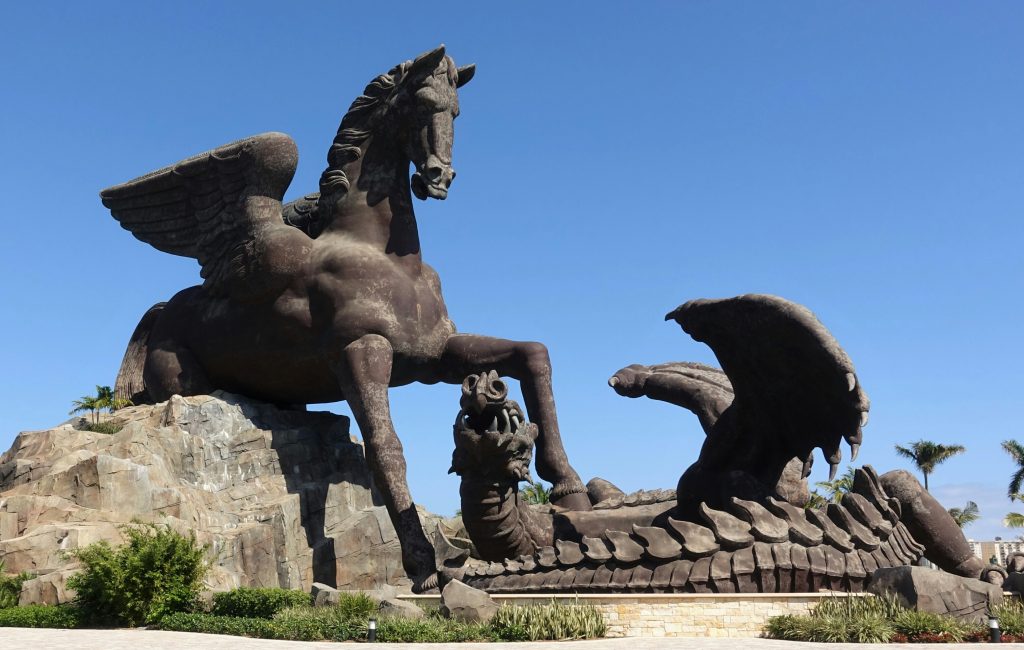
“I’ve seen some bad beats at Gulfstream, but nothing compares to the fiction sitting at the front gate. If you’re betting on the Pegasus to keep that Dragon pinned down indefinitely, you’re chasing a ghost.” Jon Stettin

I am not enjoying writing this. I didn’t like when the old Gulfstream Park was torn down for the new one. I thought the current Gulfstream Park was too small, ignored the possibility of hosting another Breeders’ Cup, and felt crowded with 10,000 people there. I came to appreciate it and ultimately enjoy it as a venue. Now it appears to be on life support.
The thunderous roar of hooves around a track, the vibrant silks of jockeys, the hope of a wager – these are the enduring images of horse racing. This is what we want associated with the sport. Yet, in Florida, this centuries-old tradition stands at a precipice. The recent legislative strides towards “decoupling” have not just nudged the industry; they threaten to fundamentally reshape its landscape, potentially leaving one of its most storied venues, Gulfstream Park, staring down a future devoid of racing, while elevating an unlikely but worthy contender: Tampa Bay Downs.
This isn’t merely a legislative tweak; it’s a seismic shift, years in the making, fueled by complex financial realities, evolving land values, and the strategic maneuvers of powerful figures. To understand the looming transformation, one must delve into the intricate history, the present legislative climate, and the speculative, yet increasingly plausible, future of Florida racing.
Decoupling: A Legislative Lasso Tightens
Decoupling, at its core, is the separation of casino operations from the requirement to host live horse racing. For years, Florida’s racinos – facilities that combine pari-mutuel wagering with other forms of gambling like slots and poker – operated under the premise that their lucrative casino licenses were contingent upon maintaining a live racing product. This was intended to support the state’s agricultural industry and preserve racing jobs.
However, the racing industry has faced declining attendance and handle for decades, while the casino side of the business has flourished. This imbalance led to a growing sentiment among many racino operators that the racing mandate was an expensive, loss-generating burden. The latest legislative push, now seemingly on the cusp of becoming law, is particularly significant because it reportedly lacks a clause mandating continued racing at Gulfstream Park for any transitional period. This omission is a crucial indicator of the legislative intent and the immediate peril facing the track.
The implications are stark: without the requirement to race, and with the substantial overheads associated with maintaining a racing facility, the economic incentive for owners to continue live racing evaporates. This is particularly true for properties where the land value far outstrips the revenue generated by racing.
Gulfstream Park: A Billion-Dollar Quandary
At the epicenter of this impending shake-up is Gulfstream Park, a legendary name in American horse racing. Established in 1939, it has hosted some of the sport’s most prestigious races, including the Florida Derby, a key Kentucky Derby prep race, The Fountain of Youth, The Donn Handicap, and its unofficial replacement, the lucrative Pegasus World Cup. Yet, its future as a racing venue is now shrouded in profound doubt, primarily due to two interconnected factors: its immensely valuable real estate and the strategic inclinations of its owner, Belinda Stronach.
The Land: A Developer’s Dream
Gulfstream Park is situated on prime real estate in Hallandale Beach, nestled between Miami and Fort Lauderdale. The value of this land is not merely significant; it is astronomical, potentially exceeding a billion dollars. For a long time, the racing requirement acted as a barrier to unlocking this development potential. Decoupling effectively removes that barrier.
Consider the economics: maintaining a world-class racing facility, with its stables, training tracks, grandstands, and all the associated infrastructure, is incredibly expensive. Staffing, purse money, maintenance – these costs run into tens of millions annually. When juxtaposed against the potential proceeds from selling or redeveloping the land for commercial or residential use in a booming South Florida market, the argument for continuing racing becomes increasingly difficult to sustain from a purely financial perspective. You can’t blame Belinda Stronach for that.
Adding to this pressure are new zoning issues in the Gulfstream area that reportedly favor development. This convergence of high land value and development-friendly zoning creates an irresistible gravitational pull for a property owner looking to maximize assets.
Belinda Stronach: A Strategic Vision Beyond the Track
Belinda Stronach, Chairman, CEO, and President of The Stronach Group (TSG), which owns Gulfstream Park, has made no secret of her evolving strategic vision. Unlike her father, Frank Stronach, a passionate horseman who built his empire with a deep commitment to racing, Belinda’s focus appears to be on optimizing assets and moving away from the operational complexities and financial challenges of a declining industry. That is a tough reality for those who love the sport but it is hard to argue against it being smart business.
Her public statements and strategic decisions have consistently signaled a diminished interest in long-term racing operations. She has explicitly stated that the area where Gulfstream is located is “not conducive to horses and a racing environment,” a comment that speaks volumes about her perspective on the site’s future. This isn’t merely a casual observation; it’s a strategic justification for potential redevelopment.
Belinda Stronach is also no stranger to high-stakes litigation, having been embroiled in a bitter legal battle with her own father over control of the family’s vast assets. This history suggests a willingness to pursue aggressive strategies to achieve her business objectives, even if it means challenging established norms or familial legacies.
The Santa Anita Parallel
The situation at Gulfstream is not isolated within The Stronach Group’s portfolio. Stronach also owns Santa Anita Park in California, another iconic track facing similar pressures. California racing has also struggled, and Santa Anita occupies incredibly valuable land in a prime Southern California location. The parallels between Gulfstream and Santa Anita are striking, suggesting a broader strategy within TSG to divest from underperforming racing assets in favor of more lucrative real estate ventures. The ultimate fate of Santa Anita, should Gulfstream cease racing, will be a keenly watched indicator of TSG’s long-term intentions.
Hialeah Park: A Fading Ghost of Glory
While Gulfstream grapples with its future, Hialeah Park represents a different facet of Florida’s racing past. Once considered the most beautiful racetrack in the world, with its iconic flamingos and stunning architecture, Hialeah ceased thoroughbred racing in 2001. It has since operated as a casino and poker room, occasionally hosting quarter horse racing to maintain its pari-mutuel license. Although hard to visualize today, there was a time Hialeah was the winter equivalent of Saratoga.
Hialeah, despite its historical grandeur, faces significant challenges as a potential thoroughbred racing venue. The property is in desperate need of a major overhaul, bordering on a rebuild, to meet modern racing standards and attract a significant audience. Crucially, without the legislative incentive to race, and with a successful casino operation already in place, there is little to no motivation for its owners to invest the hundreds of millions required to revive thoroughbred racing. Its future, post-decoupling, is almost certainly as a pure casino and entertainment complex, with its racing history relegated to memory.
Ocala: The Horse Capital’s Contradiction
Ocala, Florida, proudly declares itself the “Horse Capital of the World,” a hub for breeding, training, and equestrian sports. Naturally, it has been discussed as a potential location for future thoroughbred racing should other tracks falter. However, the reality is more complicated.
While Ocala has the infrastructure and expertise for horses, establishing a major, year-round thoroughbred racing venue would be a monumental undertaking. It would require significant investment in a new track, grandstands, stables, and all the logistical support. Moreover, the local political and economic landscape might present its own set of challenges, from zoning to community acceptance. While it remains a theoretical possibility, the complexity and cost involved likely make it a less straightforward solution compared to existing, operational facilities.
Tampa Bay Downs: The Catbird Seat
Amidst this maelstrom of uncertainty, Tampa Bay Downs emerges as the unlikely, yet eminently logical, beneficiary of Florida’s decoupling saga. Located in Oldsmar, just outside Tampa, this track stands in what can be described as the “catbird seat.” I pointed as much out when I wrote about the venues under-appreciated history.
An Existing, Running Operation with History
Tampa Bay Downs boasts a proud history dating back over 100 years. It is a well-established, operational thoroughbred racing facility with existing infrastructure, a loyal fan base, and a reputation for solid, competitive racing. Unlike the speculative notion of building a new track in Ocala, or the monumental task of reviving Hialeah, Tampa Bay Downs is already in full bloom.
Geographical Advantage and Community Support
The Tampa Bay area is a rapidly growing metropolitan region, providing a strong demographic base for potential growth in racing attendance and wagering. The track has cultivated a strong relationship with its local community and the state’s racing enthusiasts. This established goodwill and operational stability provide a crucial advantage over potential competitors.
The Last Bastion?
Should Gulfstream Park indeed cease racing, Tampa Bay Downs could very well become Florida’s premier, if not sole, thoroughbred racing venue. This would consolidate the state’s racing industry, attracting more trainers, jockeys, and horses to its grounds, and potentially leading to higher quality racing and increased prize money. It positions Tampa Bay Downs to absorb the displaced racing activities and become the undeniable hub of Florida thoroughbred racing.
The Litigation Landscape: A Familiar Foe
The Stronach Group, under Belinda Stronach’s leadership, has demonstrated a willingness to engage in litigation to achieve its objectives. The legal battles with her father, Frank Stronach, over control of the family trust and business empire, illustrate a formidable resolve to protect and grow her interests.
While the current decoupling legislation may smooth the path for Gulfstream to cease racing, any subsequent actions, particularly those related to land redevelopment or contractual obligations, could still invite legal challenges. Horsemen’s associations, labor unions, or even local community groups could attempt to litigate to preserve racing or ensure fair compensation. However, the legislative framework of decoupling significantly weakens their legal standing, as the requirement to race will have been lifted.
The Future: Uncertain, Yet Predictable Trends
The future of thoroughbred racing in Florida, while uncertain in its precise details, shows predictable trends:
- Gulfstream Park’s Transformation: The likelihood of Gulfstream Park transitioning from a racing venue to a massive real estate development, incorporating residential, commercial, and entertainment components, appears increasingly probable. The casino operations would likely continue, but the track itself would fade into history.
- Hialeah’s Casino Focus: Hialeah Park will almost certainly continue its path as a successful casino and entertainment complex, with no serious revival of thoroughbred racing.
- Tampa Bay Downs’ Ascent: Tampa Bay Downs is poised to become the undisputed center of thoroughbred racing in Florida, potentially experiencing a significant boost in prominence, field quality, and handle.
- Consolidation of Racing: The Florida racing industry will likely consolidate around fewer, stronger venues, emphasizing quality over quantity. This may lead to better racing at the surviving tracks but also a smaller overall footprint for the sport in the state.
- The End of an Era: The potential closure of Gulfstream Park would mark the end of an era for Florida racing, signifying a broader national trend where the economic value of prime real estate increasingly overshadows the historical and cultural significance of racetracks.
The Decoupling Countdown: A Timeline of Intent
Under the current legislative framework (notably HB 881, which just passed the Florida House (February 2026), the mechanism for Gulfstream Park to cease racing is both deliberate and, to many industry insiders, alarming. While The Stronach Group recently signed a three-year agreement with the Florida Horsemen’s Benevolent and Protective Association (FHBPA) to guarantee a sliding scale of race days through 2028, the law provides a permanent “out” shortly thereafter. The bill stipulates that tracks cannot even file a formal Notice of Intent to Cease Racing until July 1, 2027. Once that notice is filed with the Florida Gaming Control Commission, the track is required to maintain live racing for an additional three-year “runway.” This creates a definitive sunset period: if Belinda Stronach pulls the trigger on the earliest possible date in the summer of 2027, the final bugle call at Gulfstream Park would likely sound in 2030. This timeline serves as a precarious buffer, giving the Ocala breeding industry and Tampa Bay Downs a narrow window to absorb the impact of South Florida’s exit from the sport.
Conclusion: A New Chapter
Florida’s decoupling legislation is not just a regulatory change; it is a catalyst for profound transformation. The romantic image of racing, particularly at iconic venues like Gulfstream Park, is colliding with the hard realities of land economics and strategic business decisions. While the echoes of history will undoubtedly linger, the future of Florida racing points towards a new chapter, one where Tampa Bay Downs stands as the enduring beacon, while the once-dominant Gulfstream Park transitions from the roar of the crowd to the quiet hum of development. The starting gate is closing, and the race for Florida’s racing future has a clear frontrunner.
Summary of Key Dates:
2030: The projected final year of racing at Gulfstream if the notice is filed at the first opportunity.
December 31, 2025: Gulfstream and Horsemen signed a 3-year deal to prevent an immediate shutdown.
2026–2028: Minimum race days decrease annually (180 in ’26, 140 in ’27, 120 in ’28).
July 1, 2027: The earliest legal date Gulfstream can officially notify the state of its intent to stop racing forever.