

The Most Powerful People in Horse Racing
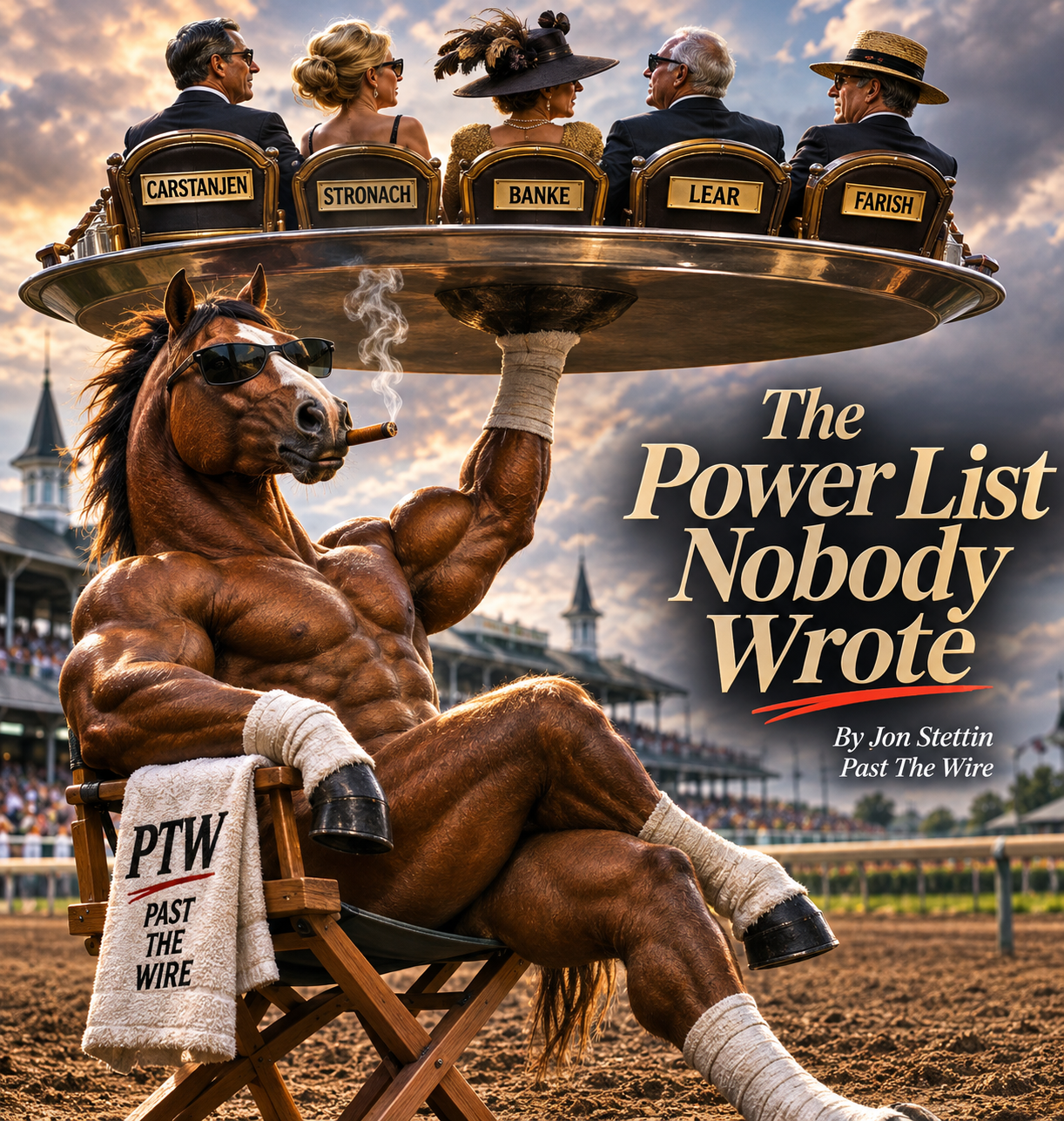
I saw a question making the rounds on social media this week: Who are the five most powerful people in American Thoroughbred racing? I read the answers. Bill Carstanjen. Belinda Stronach. Barbara Banke. Bill Farish. Over and over, like a chalk ticket.
It got me thinking, and what jumped out at me wasn’t the names. It was how differently I looked at the question. Most people answered it like an owner would: Who has the most stuff? I’ve spent my life as a horseplayer, and a horseplayer asks something else. Who sets the price? Who writes the rules? Who controls the information? Who controls the horses? And who will still be standing in five years?
That’s the lens. Money, rules, data, horses, and time. Power is the ability to change how this sport works, not the size of the box at the Derby.
So I built a long list of twelve, then cut it to five. My five. Some obvious names didn’t make it. Some names most racing fans wouldn’t recognize did. That’s the point.
Influence, popularity, prestige, money. People confuse all of them with power. None of them is power alone. Power is the ability to change how the game works. The quietest person in the room is usually the one to watch, because real power doesn’t need to announce itself. It only looks like something else to people who’ve never seen the real thing.
When I wrote about the Kinahan Cartel and its reach into racing, I wrote a story nobody else in American racing media could have written, and none of them would have tried. I knew exactly how far I could go before I wrote a word. Most of the people who talk loudest in this industry wouldn’t know where to start. That’s a kind of power most people in this game have never seen, and never will. It doesn’t sit on a board or show up in a winner’s circle photo. It exists all the same. Not long after that piece ran, Daniel Kinahan was arrested in Dubai and extradited to Dublin, where he was charged with directing a criminal organization. The charges had nothing to do with racing.
Why the Usual Suspects Don’t Make My Cut
Bill Carstanjen. He runs the Kentucky Derby, TwinSpires, and now all of United Tote after Churchill bought back NYRA’s 49% interest. That’s real power. Nobody can argue otherwise. But he answers to a public board and shareholders, and Churchill’s stock has taken a beating this year. The company has been selling regional casino assets. Power that can be overruled by Wall Street on an earnings call is power on loan. It doesn’t mean he isn’t powerful. It means there are people above him who can take that power away.
Belinda Stronach. Santa Anita, Gulfstream Park, AmTote, and a controlling interest in Elite Turf Club. An enormous footprint. But Gulfstream has pushed to decouple racing from its casino, and its agreement with Florida horsemen provides for a reduced racing schedule by 2028. How much power over the future of a sport do you really have if you’re positioning yourself to potentially participate less in it? She controls considerable assets. Whether she controls racing’s direction is another question.
Barbara Banke. She chairs the Breeders’ Cup board, and Stonestreet is a powerhouse in breeding and racing. I respect both accomplishments. But the Breeders’ Cup is a championship event governed by a board. It showcases the sport. It doesn’t control the sport’s daily economics, wagering infrastructure, or regulatory direction. There is a difference.
Bill Farish and Bill Lear belong in the conversation as well. They have institutional influence, relationships, and considerable standing within the industry. But influence and authority aren’t always the same as leverage. I am looking for the people who can change the equation, not simply participate in the discussion.
That’s where my list goes in a different direction.
The Long List: Twelve Outside the Box
Before settling on five, I considered twelve sources of power. Some are people, some are institutions, and some are the individuals controlling the machinery behind the institutions.
| Candidate | The lever |
|---|---|
| Elite #2 | Money and wagering economics |
| Scott Daruty, Elite Turf Club | CAW access and wagering relationships |
| Lisa Lazarus, HISA | Rules and enforcement |
| The United States Supreme Court | Constitutional authority |
| Judge Joan Azrack | Judicial authority over CAW litigation |
| Jim Gagliano and his successors, Everett Dobson, The Jockey Club | Registry and institutional authority |
| Kyle McDoniel, Equibase | Data and access |
| Keith Johnson and Andrew Archibald | Wagering infrastructure |
| Sheikh Mohammed, Godolphin | Horses and breeding capital |
| John Magnier, Coolmore | Horses and breeding capital |
| Mike Repole | Capital, ownership, and public influence |
| Josh Shapiro, Pennsylvania Governor | Legislative and subsidy influence |
Now, the five.
1. Elite #2: The Price
No names. They don’t need them.
They operate in a world where the price of a wager isn’t necessarily the price printed on the ticket. The economics are negotiated. Rebates, access, volume, and technology determine the playing field. The average horseplayer gets the posted takeout. The biggest computer teams can negotiate something entirely different.
That’s power. Not the kind that gets you invited to cut a ribbon. The kind that makes the people cutting the ribbon answer your phone calls.
The computer-assisted wagering operations have become so important to handle that racetracks must consider their reaction when changing wagering policies. When NYRA introduced restrictions intended to address late odds changes and the impact of CAW wagering, it accepted a significant reduction in handle. Estimates put the initial decline at as much as 10%.
Think about that. An industry constantly talking about growing handle had to weigh giving up a meaningful portion of it to change how certain customers participate.
That isn’t proof that one account controls 10% of NYRA’s business. It is proof of the collective leverage these operations possess. And the biggest players within that group have negotiating power ordinary customers can only imagine.
We’ve written about this world before. Our examination of The Joker and the Milkman offered a look at what power can resemble when wagering capital, sophisticated technology, and preferential economics intersect. You don’t have to own the racetrack to influence the price of its product.
The public sees a racetrack executive announcing another initiative to attract customers. I see a wagering operation whose business is important enough that the executive must consider what happens if it takes its money elsewhere.
Here’s my test: If Elite #2 walked away tomorrow, how many executives on those other power lists could comfortably say good riddance?
I suspect we know the answer.
2. Lisa Lazarus: The Rules
The people who own the racetracks have to operate under the rules of the Horseracing Integrity and Safety Authority. Lisa Lazarus runs it.
HISA establishes national safety standards and, through its anti-doping and medication control program administered by HIWU, exercises authority that reaches directly into the barns, training schedules, and careers of participants across most American Thoroughbred racing jurisdictions.
Its rules are subject to Federal Trade Commission oversight, but that doesn’t diminish the reach of the institution. Its proposed 2027 budget is approximately $72.7 million, with the majority devoted to anti-doping and medication control.
A trainer can be a Hall of Famer. An owner can be a billionaire. A racetrack can be part of a publicly traded corporation. None of that provides immunity from the regulatory system.
You can own the horse. You can own the track. You can own the company. You don’t own the rules.
Now, there is a rather significant potential obstacle to that power, and it sits at One First Street in Washington, D.C.
The Fifth Circuit has found constitutional problems with HISA’s enforcement structure, while the Sixth Circuit has upheld the law. Petitions are before the Supreme Court, with the cases scheduled for consideration at its December 4 conference.
The Court could decline to intervene, or it could take up questions that affect the authority’s future. That’s an extraordinary amount of uncertainty hanging over an organization with extraordinary regulatory reach.
Until something changes, however, Lazarus occupies a position no racetrack owner can duplicate.
She doesn’t have to own the horse to affect whether it races.
3. Godolphin and Coolmore: The Horses
Sheikh Mohammed and John Magnier. Two names, one position. I’m treating their operations together because the power I’m measuring is the same, and their competition helps define it.
Godolphin and Coolmore don’t simply buy expensive horses. They help establish the market in which everybody else buys and breeds horses.
Through Darley and Coolmore’s Ashford Stud in Kentucky, their breeding operations influence bloodlines, stallion valuations, mating decisions, and the commercial direction of the Thoroughbred for generations.
They have the resources to buy at the top of the market, develop their own horses, and stand stallions whose offspring become the next generation of racing and breeding stock.
That is a different kind of power from controlling a racing calendar or negotiating a simulcast agreement.
The people who control the racetracks control where the horses run. The people who shape the bloodlines influence what horses will be running twenty years from now.
That’s a long game.
A racetrack can change ownership. A racing association can replace its executives. A company can sell assets or decide the economics no longer make sense.
Bloodlines don’t work that way. Their influence can continue long after the people who made the original decisions are gone.
If we’re going to talk about power in American Thoroughbred racing, ignoring the people who help determine the future American Thoroughbred makes no sense.
And unlike some of the names on the popular lists, these operations have demonstrated a willingness to invest across generations, not merely across fiscal quarters.
4. Kyle McDoniel: The Data
Here’s one most racing fans probably wouldn’t think of.
Kyle McDoniel runs Equibase, the official source of racing information in North America.
On the traditional organizational chart, The Jockey Club sits above Equibase. Jim Gagliano has exercised enormous institutional authority, and his retirement will create a transition in that leadership. But when I look at where racing is headed, the data side of the business interests me more than the titles. Everett Dobson is powerful, influential, but as Head Steward, he is somewhat limited to ideas and suggestions as opposed to implementation.
Every official chart, result, and licensed data feed is part of an information ecosystem that handicappers, wagering platforms, analytics companies, and racing businesses depend upon.
Not every past performance product comes directly from Equibase, and not every private handicapping model depends exclusively on its data. But Equibase occupies a central position in the official information supply chain.
And Kyle understands what that position is worth.
He came from Sportradar, where he worked in the world of official sports betting data and relationships involving major professional leagues. He understands licensing, distribution, and the commercial value of information.
The Jockey Club and Equibase have introduced the Thoroughbred Data Hub. The larger question is how access to racing data will be structured and priced as the industry moves toward increasingly sophisticated wagering technology.
Who gets access? At what price? Under what conditions? Can smaller developers compete? Can new products enter the market without prohibitive costs?
Those aren’t academic questions. They help determine who gets to build the next generation of tools for horseplayers.
When information becomes the raw material of wagering, controlling access to that information becomes a form of power.
I’ve spent enough years handicapping races to understand the value of information. I’ve also spent enough years in this business to recognize the difference between someone who possesses information and someone who can decide how it is distributed.
Kyle belongs on my list because he sits at that intersection.
Most fans couldn’t pick him out of a lineup. That doesn’t make his position any less important. It might make my point.
5. Mike Repole: The Wild Card
This is the selection people will argue about, and that’s fine.
Mike Repole has money, horses, a substantial public platform, and absolutely no reluctance to use any of them.
He has invested heavily in Thoroughbred racing, won at its highest levels, and publicly challenged some of its most powerful institutions. The Jockey Club, Equibase, HISA, Churchill Downs. He isn’t particularly concerned about whether the people running those organizations appreciate his opinions.
He also disclosed purchasing approximately $80 million in Churchill Downs stock, representing a meaningful minority position in the publicly traded company.
I’ve questioned whether investing in Churchill is consistent with some of the accountability he has demanded from its leadership. He faced and answered those questions head on.
Here’s the distinction.
Repole has demonstrated that he can command attention and force uncomfortable conversations. What remains to be seen is whether he can convert that influence into structural change.
That is why he’s my wild card rather than my number one.
He can walk into a shareholder meeting as an investor, a racing boardroom as an owner, and a major winner’s circle as someone who has earned his place there. He can also take his argument directly to the public as Mike from Queens without waiting for permission from an industry organization.
Very few people possess that combination. Does it guarantee results? Absolutely not. But we are already seeing them.
Power isn’t always about what someone has already accomplished. Sometimes it’s about the options available to them and their willingness to exercise those options.
Mike has options. He has resources. And he has shown he isn’t afraid to make people uncomfortable.
Whether and how much that changes racing remains an open question.
Who Got Cut, and Why
Scott Daruty. He is one of the most interesting people in the entire exercise. Elite Turf Club and Monarch Content Management place him close to both high-volume wagering and the distribution of racing signals. That’s substantial influence. But he’s operating within a structure owned and controlled by others. The customer bringing enormous wagering volume may ultimately possess greater negotiating leverage than the executive facilitating the business. Daruty is important. I’m just not convinced he’s more powerful than the people whose business the platform exists to serve.
The Supreme Court. Potentially the most powerful institution on the long list, but it doesn’t belong in a ranking of individuals exercising ongoing influence over racing. A ruling could dramatically alter HISA’s authority. The Court might also decline to hear the cases. Either way, that is judicial power applied to a particular dispute, not someone steering the business every day. I am not even touching on the likelihood they decide the future of prediction markets and the role they play in sports wagering including horse racing.
Judge Joan Azrack. The CAW litigation demonstrates how much influence a federal judge can exercise over access to discovery and the progression of a case. The court’s handling of the litigation has already affected what the parties can pursue and when. But the authority is limited to the matters before the court. That’s considerable power over a case, not necessarily power over the industry.
Jim Gagliano and The Jockey Club succession. Gagliano has wielded meaningful institutional authority. The registry is fundamental to the sport, and The Jockey Club’s reach extends well beyond registering horses. But succession is underway, and I am more interested in where future commercial leverage will reside. The registry remains essential. The economics of information may become even more consequential.
Keith Johnson and Andrew Archibald. AmTote and United Tote provide critical wagering infrastructure. Without tote systems, the pari-mutuel business doesn’t function. But the executives running those systems operate within larger corporate ownership structures. Churchill controls United Tote, while AmTote is part of 1/ST’s technology business. They run important machinery. The owners ultimately determine corporate strategy. That’s the distinction that keeps them off my final five.
Josh Shapiro. Pennsylvania’s racing industry depends heavily on casino-funded purse support, and state government has the ability to alter those economics through legislation and budgeting. That’s real power, and it can be devastating when exercised against racing. But it is largely confined to one jurisdiction. Every state dependent on gaming subsidies has its own version of that vulnerability. The governor doesn’t need to understand a condition book to affect whether a racetrack survives.
There are others I could have included. David O’Rourke at NYRA. Bill Nader with the Thoroughbred Owners of California. People who negotiate signal agreements, influence racing dates, or exercise veto authority over wagering arrangements.
All have power.
The question is how much, over whom, and for how long.
The Bottom Line
Money, rules, horses, data, and a wild card.
A computer wagering operation most fans couldn’t identify. A regulator with federal authority behind her. Two breeding empires shaping the Thoroughbred for generations. A data executive whose decisions can influence who gets to compete in tomorrow’s wagering marketplace. And a billionaire willing to challenge the establishment while buying a piece of it.
That’s my five.
Not necessarily the five richest. Not the five most recognizable. Not the five with the nicest offices or the best seats at the Derby.
The five I would be watching if I wanted to understand where the leverage really is.
There’s a difference between being important and being powerful. There’s a difference between being invited into the room and being someone the people in the room cannot afford to ignore.
Horseplayers understand that distinction better than most.
We don’t look at a race and automatically assume the favorite is the most likely winner at the right price. We look beneath the surface. We examine the conditions, the pace, the trips, the intentions, the information, and the market. We try to understand what everybody else may have missed.
Why would I look at the racing industry any differently?
The public asks who’s holding the trophy. The pros ask who’s setting the price.
In The Usual Suspects, Kevin Spacey’s character says the greatest trick the Devil ever pulled was convincing the world he didn’t exist.
In racing, the greatest trick power ever pulled was convincing the world it belonged to the people on everyone else’s list.

Comments