
The Illusion of Unification: Control is Not Stewardship
Horse racing talks a lot about transparency. We hear about unity. Collaboration. Leadership. Doing what’s best for the horse and for the future of the sport. Those are good words. Necessary words. But lately something interesting has been happening when uncomfortable questions are raised in this sport. The conversation doesn’t explode. It doesn’t even become a debate. Instead, it tends to split into two separate conversations happening in two different places.
One inside the system.
One outside it.
And the two rarely meet.
A recent series of events provides a clear example.
Just yesterday industry leader Everett Dobson delivered remarks calling for greater unity and alignment across Thoroughbred racing. The message resonated with many who care deeply about the future of the sport. Unity, after all, is easy to agree with in principle. But unity is not built through speeches alone. It is built through dialogue — especially when the questions being asked are uncomfortable ones.
The First Question
Recently, Past the Wire published articles examining policies connected to the grant program of the Thoroughbred Aftercare Alliance. The focus was straightforward. One article examined the existence of a non-disparagement clause tied to grant funding.
Another published the experience of a rescue organization that described difficulties within the accreditation process.
The underlying question wasn’t complicated: When funding is connected to restrictions on criticism, does that discourage organizations from speaking openly about problems? It’s a legitimate question in any industry. And certainly in one that frequently emphasizes transparency.
The Phone Call
After those articles appeared, a representative connected to the TAA reached out directly to discuss the coverage. The conversation was candid. The concern raised was not about the existence of the clause itself, but about how it was characterized and whether it was “fact checked”.
During that discussion, a distinction was made between “control” and “censorship.” She insisted that their non-disparagement policy wasn’t “censorship.” Her word for it? “Control.” Let that sink in.
Past the Wire explained that the rescue’s account reflected its experience and that the existence of the clause had been fact-checked.
The exchange remained professional. And an opportunity emerged.
The Offer
During that same conversation, Past the Wire was presented with a simple offer.
If the TAA wished to connect the publication with rescues that had positive experiences with the program, would those voices be welcomed and considered for publication. In other words, if there were another side to the story, was the door open. Of course we agreed and looked forward to the opportunity.
No such submission followed.
Soon after, discussions highlighting the positive work of aftercare organizations began appearing through other industry channels.
Articles and conversations surfaced through platforms connected to the sport’s institutional media ecosystem, including outlets such as BloodHorse and the RailTalk podcast.
The conversation continued. Just not in the same place where the original questions had been asked.
A Familiar Pattern
That dynamic has appeared in other areas recently as well.
When Mike Repole raised concerns about leadership and governance in the sport, the response was largely indirect. A rebuttal letter was published in The Paulick Report, who runs articles sponsored by The Jockey Club and derives revenue from its stewards.
Discussions take place. But rarely in the same forum where the criticism originated.
Westlake Stables has chosen social media to pose their questions and concerns, they continually state no response whatsoever.
And when Past the Wire published articles examining structural questions involving reserves held by institutions such as The Jockey Club and the financial strategy of the Breeders’ Cup, the response again came more through messaging than direct dialogue.
Which brings us to the most recent invitation.
Another Offer to Talk
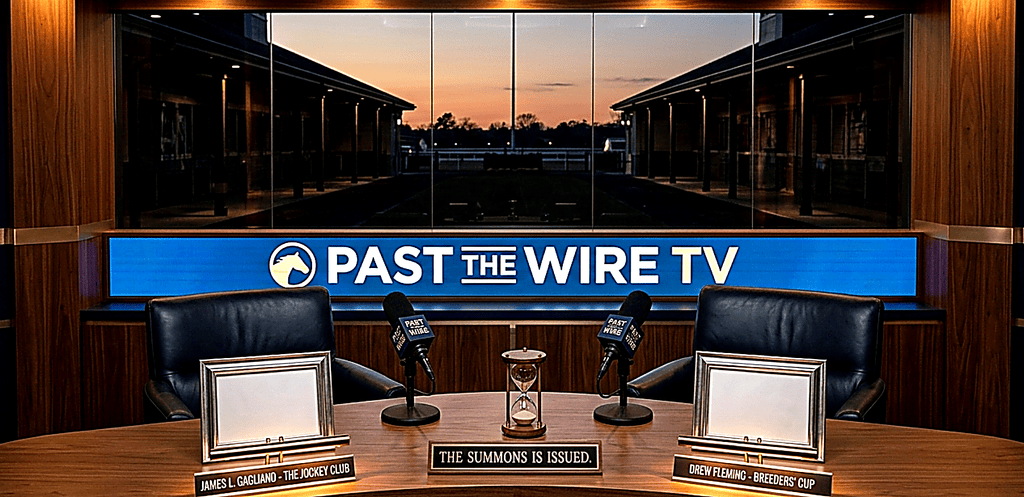
Prior to the publication of the article “The Allegiance Gap: When Keynotes and Ledgers Don’t Align,” which referenced comments made by industry figure Everett Dobson about unity and leadership in racing, Past the Wire extended another invitation.
This one was directed to two of the most influential executives in the sport:
Drew Fleming
and
Jim Gagliano.
The invitation was straightforward. Join a live forum on Past the Wire TV. Not a debate. Not a confrontation.
Just a professional discussion about the issues that have been raised — from the shrinking foal crop to the use of institutional reserves and the broader direction of the sport.
The idea was simple. If the industry is going to talk about unity and leadership, perhaps the most constructive step is to sit down and answer the questions people are asking. As of this writing, that invitation remains unanswered.
Two Conversations
None of this suggests that the industry isn’t communicating. Clearly it is. Statements are issued. Articles appear. Podcasts discuss the issues. But increasingly those discussions seem to occur within the sport’s existing institutional platforms, where the emphasis tends to be on positive initiatives and ongoing progress. Meanwhile, questions raised outside that framework often remain unanswered in the same forum where they were originally posed. The result is subtle but noticeable.
Two conversations happening at the same time.
One inside the system.
One outside it.
Why That Matters
Horse racing is facing serious challenges. Horses are meeting undeserved horrific but avoidable fates. Foal crops are declining. Tracks are disappearing. CAW’s cannibalize pools and support and sustain handle simultaneously. Prediction markets are at the door and may very well have the key to it.
The economics of the sport are under pressure. At moments like this, the industry doesn’t suffer from too much dialogue. It suffers from too little of it happening in the same room. Independent voices asking questions and institutional leaders explaining decisions should not be opposing forces. They should be part of the same conversation. Because the people who care about this sport — owners, breeders, horseplayers, fans — deserve to hear both sides.
The Door Remains Open
The invitations extended by Past the Wire were never intended as challenges.
They were opportunities. Opportunities to explain. Opportunities to answer questions. Opportunities to bring the sport’s leadership and its stakeholders into the same conversation.
Those opportunities remain open.
Because if horse racing is going to navigate the difficult road ahead, it may eventually need something the sport has historically struggled with: Not just messaging. But conversation.
Never Complain, Never Explain: