
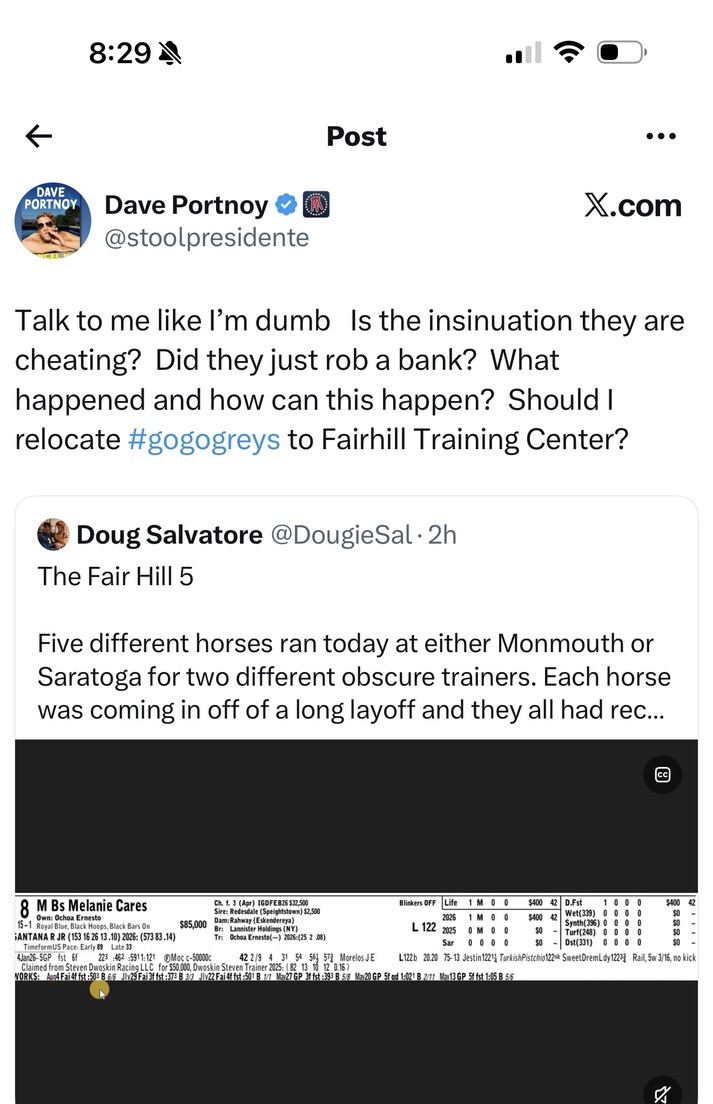

Horse racing taught me long ago that when something doesn’t look right, it doesn’t automatically mean something illegal occurred. It just means you start looking. That is where we are today. Sunday produced a string of results at Saratoga and Monmouth Park that immediately caught the attention of serious horseplayers. Social media did what it always does: accusations flew, conclusions were jumped to, and serious allegations were thrown around before anyone had basic facts. We aren’t going down that rabbit hole without evidence. What we are going to do is look at what actually happened on the track.
The Saratoga Winners
At Saratoga, trainer Ernesto Ochoa sent out two horses, and both won.
In Race 4, Classic Rock won a $35,000 maiden claiming sprint. The past performances show he was previously trained by Eduardo Azpurua Jr., with published workouts listed at Fair Hill on July 1, July 10, and July 29.
Ochoa’s second winner, M Bs Melanie Cares, took an $85,000 claiming race. She was claimed for $50,000 out of Steven Dwoskin’s barn at Gulfstream back on January 4. Her paper trail heading into Saratoga included published Fair Hill works on July 29 and August 4.
Neither horse showed the kind of workout pattern that jumps off the page in the Form. In fact, some of those published works were decidedly ordinary. That doesn’t prove anything, but considering what happened when the gates opened Sunday, it certainly makes the pattern worth examining. There is also a trainer and ownership trail to reconstruct here. Horses change barns and ownership all the time in this game, particularly through the claiming box. That is nothing unusual by itself. But if we are going to understand what happened Sunday, we want to know exactly where these horses came from, when they changed hands, where they were stabled and what happened between their previous starts and Sunday.
The Monmouth Double
A few hours away at Monmouth Park, trainer Angel Quiroz won consecutive races. The Great Amira won the third race paying $37.20. Her past performances show published Fair Hill works on July 1, July 24, and August 3. In the very next race, Quiroz brought out Tepeyac, who won and paid $9.60. His workout line shows a similar Fair Hill pattern: July 1, July 29, and August 4. Add those up: two trainers, two tracks, four wins on the same afternoon, and every single horse shows recent published workouts listed at the same facility, Fair Hill. That is a documented fact. What it actually means is an entirely different question.
Separating Fact From X Noise
Once the results hit, social media exploded with allegations ranging from pool manipulation and performance enhancers to coordinated betting schemes and South Florida connections. Names were named, accusations were made, and screenshots and text messages started circulating.mLet’s be clear: an X post, a text message, or a cropped screenshot is not evidence. Right now, none of those online claims have been independently verified. However, the documented facts do justify looking deeper, and the wagering pools are one place we are looking.
We are analyzing the multi-race pools, probable payoffs and betting timelines to determine whether the wagering showed anything unusual or whether the results simply caught sophisticated bettors including Computer Assisted Wagering players flat-footed. There is an important distinction there. A horse winning at a big price doesn’t prove somebody knew something. An unusual payoff doesn’t prove pool manipulation. A horse dramatically improving doesn’t prove the horse was given something. Those things can be clues. They aren’t conclusions. And there is a tremendous difference between the two.
Where We Go From Here
The most obvious common thread we can document right now is Fair Hill. We want to know where these horses were physically stabled, who supervised them, how the published workouts were generated and reported, who clocked them, and what formal connections, if any, exist between these barns. We also want to reconstruct the ownership and trainer changes involving these horses and look at their performances before Sunday against what we saw Sunday.
Then there is the money. We know what the horses paid individually. That doesn’t tell us nearly enough. We want to look deeper into the doubles, Pick 3s, Pick 4s and other multi-race wagers where combinations involving horses like these can tell a considerably different story than simply looking at win odds. Maybe we find something. Maybe we don’t. We know the wins happened. We know the published workout lines. We know four horses connected to two trainers won at two different racetracks on the same afternoon. And we know the noise started almost immediately. What we don’t know, and what nobody on social media actually knows yet, is whether anything improper took place.
If there is a story here, we will report it. If it turns out to be nothing more than a weird afternoon where two trainers got hot off Fair Hill layovers, we will report that too. We’re running down the ownership and trainer changes, the workout paper trail, the tote data and the wagering patterns, and we’re sticking strictly to what can be proven.
Stay tuned.
Things That Make You Go Hmmmmmmm: