

 Brought to you by AmWager
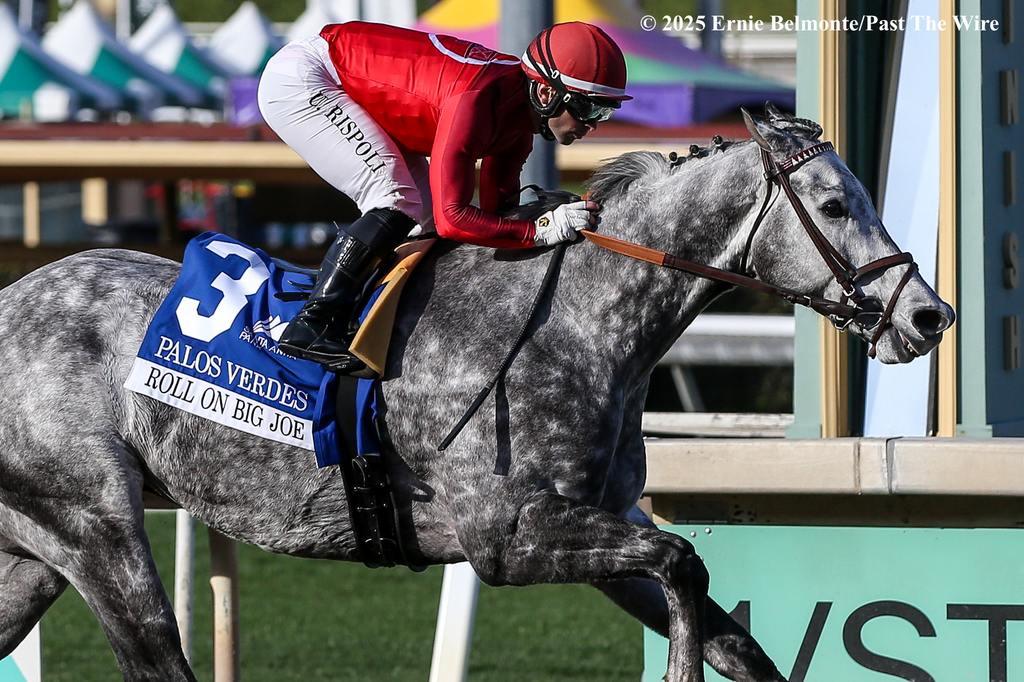
Roll On Big Joe. (Ernie Belmonte/Past The Wire)
James Gazzale
One of the hardest parts of handicapping isn’t picking the best horse — it’s understanding how a race is going to unfold. Who’s going to make the lead? Who’s going to be forced into chasing? Who’s going to be doing their best running when it actually matters?
That question is exactly why Pace Points was created.
At its core, Pace Points is a data product designed to simplify something handicappers often overcomplicate: early and late pace, relative to the field. Instead of guessing based on scattered running lines or trying to mentally adjust fractions from different races and class levels, Pace Points provides a clear ranking of who figures to be forward early and who projects to finish strongest late — all within the context of the race in front of you.
👉 To learn more about Pace Points and how it’s calculated, visit the Pace Points page on PastTheWire.com.
A perfect example came during opening weekend at Oaklawn Park in the Ring the Bell Stakes. On paper, there wasn’t a slam-dunk front-runner. Several horses had shown early speed at different times in their careers, but nothing that screamed “clear pace advantage” just by scanning the past performances.
Pace Points told a different story.
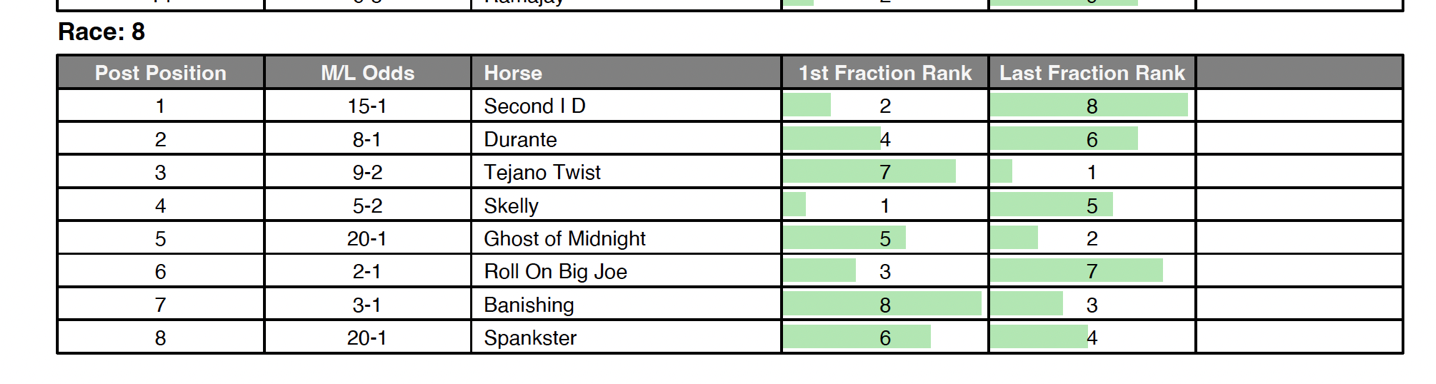
The early pace rankings highlighted a small group of horses most likely to apply pressure early. When the gates opened, that projection played out almost immediately. One horse broke poorly, another got shuffled back, and suddenly Roll On Big Joe found himself in an ideal spot — forward, clear, and unbothered.
That early positioning changed everything.
Despite not ranking especially high on the late pace scale, Roll On Big Joe was able to control the race because of how efficiently he used his early energy. He turned for home with a clear advantage, and while late runners like Banishing and Tejano Twist made runs, they simply had too much ground to make up.
That’s a key lesson when using Pace Points: early and late rankings aren’t predictions of finish order. They’re tools to help you visualize race shape, trip dynamics, and energy distribution.
👉 If you want to see how Pace Points can help you spot pace advantages before race day, check out the full Pace Points product on PastTheWire.com.
Late pace matters — but only if a horse is in position to use it. In this race, the data helped identify why the winner didn’t need a big late kick. The race was effectively decided in the first 20 seconds.
Pace Points works best when used alongside your normal handicapping process. Combine it with past performances, replays, post position, and class analysis, and suddenly the race comes into focus. You’re no longer reacting to what happened — you’re anticipating what’s likely to happen.
That’s the goal.
👉 Ready to add Pace Points to your handicapping arsenal? Visit PastTheWire.com and explore how early and late pace rankings can give you a clearer edge.
Because the more clearly you can see the race before it’s run, the better decisions you’ll make when it’s time to bet.