

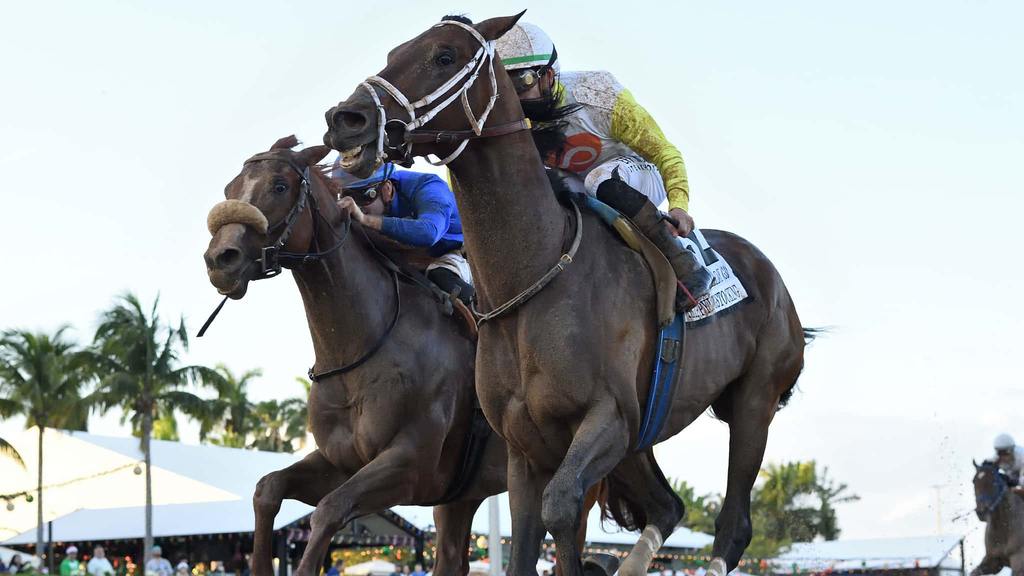
Skippylongstockings proves best in the 2025 Harlan’s Holiday, Gulfstream Photo
James Gazzale
Pace Points is designed to rank horses relative to the field in two critical phases of a race: the first fraction (early pace) and the last fraction (late pace). It’s not a prediction of exact running order. Instead, it’s a framework that helps visualize race shape before the gates open.
One of the biggest challenges in horse racing handicapping isn’t identifying talent. It’s understanding how a race is likely to unfold. That’s where Pace Points comes into play, and the Harlan’s Holiday Stakes at Gulfstream Park offered a textbook example of how early and late pace rankings can sharpen that picture.
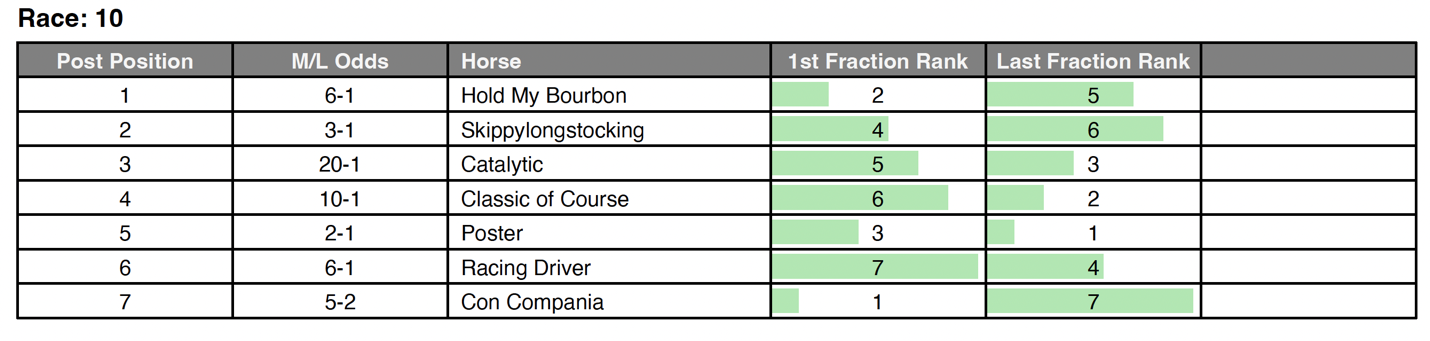
In the Harlan’s Holiday, the early Pace Points rankings suggested a contested pace. Horses like Hold My Bourbon, Con Compania, and Skippylongstocking were all projected to be involved early. That immediately raised a key handicapping question: would the speed collapse, or would one of those forward runners be able to control the race?
Hold My Bourbon answered part of that question quickly by gunning hard from the rail. But Pace Points already hinted at the risk. While ranked highly early, his profile suggested limited staying power, and once the fractions clicked off in 22-and-change and sub-46 to the half, the writing was on the wall. That kind of pace almost always invites pressure.
On the other side of the equation sat Poster, ranked No. 1 in the late Pace Points. On paper, he looked like the ideal beneficiary of a fast early tempo. And for much of the stretch run, the race seemed to be unfolding exactly that way.
But Pace Points also help explain why the obvious closer doesn’t always get there.
Skippylongstocking, despite a lower late ranking, secured an ideal trip. He stayed within striking range early, avoided excessive ground loss on the turn, and launched first. Poster, meanwhile, was forced wider, a subtle but decisive difference. When horses are evenly matched, trip efficiency matters as much as raw finishing ability.
This is a crucial takeaway: Pace Points don’t replace traditional handicapping. They refine it. The late rankings correctly identified Poster as the strongest finisher. The early rankings correctly showed which horses would shape the pace. What ultimately decided the race was how those two elements intersected in real time.
For bettors, this kind of insight can mean tighter tickets, fewer unnecessary spreads, and a clearer understanding of where risk actually lies. That’s especially valuable in stakes races, where margins are thin and prices are compressed.
If you want to see how Pace Points are built and how to apply them to your own handicapping, visit PastTheWire.com/Pace-Points to learn more. You’ll find detailed explanations and examples just like this one.
The Harlan’s Holiday didn’t contradict the Pace Points data, it validated it. The numbers told us where the pressure would be, who could finish, and where the vulnerability lived. The rest was up to trip, timing, and execution.
To explore how Pace Points can improve your race analysis and ticket construction, head to PastTheWire.com/Pace-Points and see how this tool fits into your everyday process. And as more races like the Harlan’s Holiday show, understanding pace isn’t about predicting outcomes, it’s about preparing for them.
Learn more about Pace Points and start applying them today at PastTheWire.com/Pace-Points.