
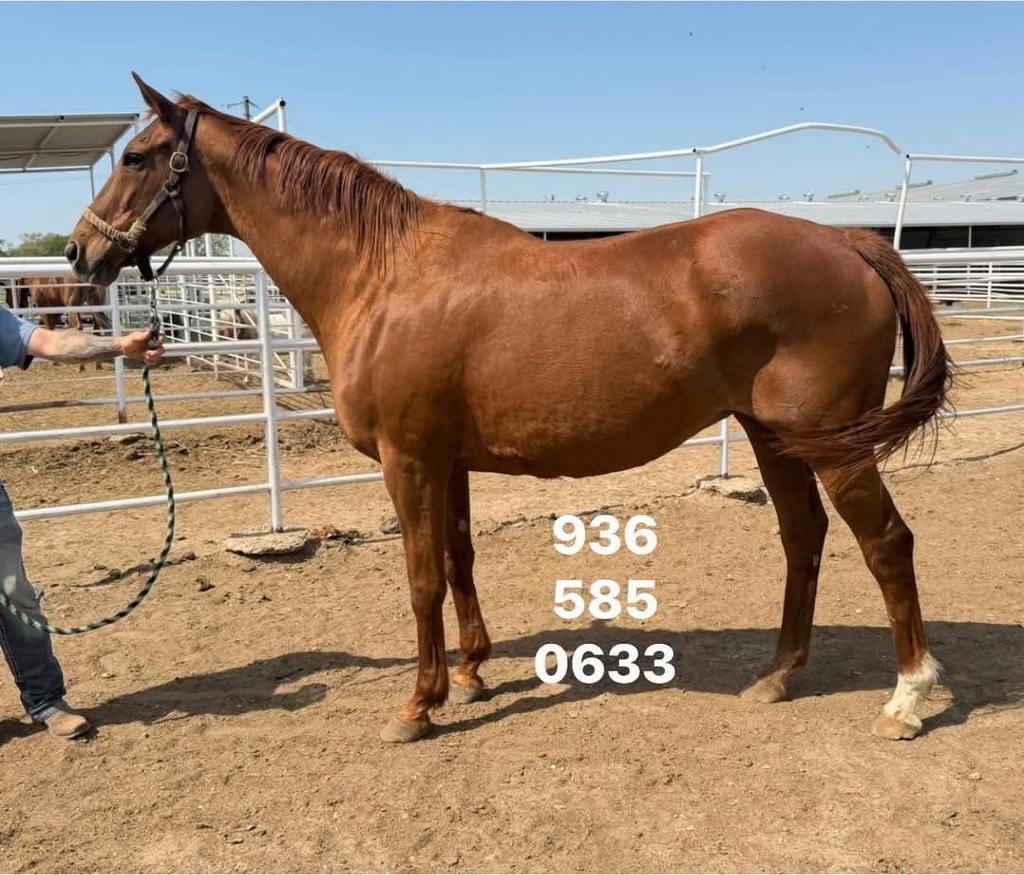
Photo: The Bridge Sanctuary X feed
The industry has the money, the mechanism, and the moral obligation to stop the broodmare slaughter pipeline. It has simply chosen not to.
My mother’s nickname was Ginger. She could outdance Ginger Rogers herself at The Roseland Ballroom in New York City, and in my younger days a bit of that luckily rubbed off on me — though The Roseland was long gone by that time. One of her handicapping techniques, if you could call it that, was to bet any horse whose name contained a word or phrase that meant something to us. It was, objectively, ridiculous. The horse always won. Any horse with Ginger in the name was an automatic play, and if I missed one that crossed the wire first, I already knew what was coming: “How could you not have that horse?” It always did. So when I saw the photographs of Ginger Brew — Sovereign Award winner, Queen’s Plate runner-up, a mare Gulfstream Park once thought worthy of naming a stakes race after — standing in a Texas kill pen this week, it hit different. My Mom would have had her. And she would have wanted to know how the industry that profited from this mare for sixteen years let it come to this. So do I. I wrote them an open letter. I offered them an empty chair. They didn’t come. You tell me — where does the horse come first? I don’t see it. I usually do this at the end, this one goes at the beginning.
Help Me Help You:
She earned a fortune for her billionaire owner-breeder. She produced foals by Medaglia d’Oro, Giant’s Causeway, Awesome Again, Bernardini, and Ghostzapper. When her foals stopped performing on the track, she was bred to lesser sires, then discarded — sold for approximately $90,000, about one-tenth of what she earned in her racing career. Gulfstream Park had even named a stakes race after her. None of it mattered when the ROI ran dry.
This is not a tragedy of ignorance. This is a tragedy of architecture.
The Two-Tier System
Ginger Brew is safe tonight. She was rescued because she was famous. Because her name triggered recognition in the right circles. Because the people who hold the levers of institutional aftercare mobilized — quickly and decisively — for a mare whose pedigree and race record gave her visibility that most broodmares will never have.
Margaret Ransom of The Bridge Sanctuary has worked this pipeline without a spotlight for years. She doesn’t get to choose which mares are worth saving based on their stakes record. She watched this unfold and said what needed to be said:
This is a classic example proving that any class of broodmare — from blue bloods to the more ‘average’ pedigree — can be dumped into the slaughter pipeline. And are.
Ransom acknowledged the organization stepping up for Ginger Brew is one that does the work — that has pulled mares from kill pens and lost some they couldn’t save in time. Her criticism was not of them. It was of the system that decided, this time, to pay attention.
For some twisted and arrogant reasons, to those in charge of aftercare — and I know their hands are all up in this deal — this mare’s life mattered more than the others. And it’s appalling.
She closed with the words that should hang on the wall of every Jockey Club board meeting until this is resolved:
For every Ginger Brew, there are three or four who languish and eventually disappear. Nearly all aged broodmares. And I am so full and I cannot help a single one and it hurts my heart.
That is not a rant. That is a witness statement from someone inside the rescue infrastructure, watching the pipeline operate in real time while institutional money sits untouched.
The Fix Is One Rule Change Away
Prominent owner Maggi Moss cut to the core of what this moment demands:
Here’s a novel idea — the @JockeyClub — change one rule as a registry. Saying you can’t act unless the state takes action — change the rule. If direct evidence shows you discard your broodmares to kill auctions/kill buyers, your privileges to register are revoked. How simple is that?
It is exactly that simple. And it is not a novel idea at all — it is the same structural argument I raised in my open letter to The Jockey Club’s Board of Stewards.
In that letter, I called for destination-based registration bans — stripping registry privileges from anyone who ships horses to a jurisdiction or channel flagged for welfare violations — and for mandatory Transfer of Ownership reporting for every change of hands, including non-racing sales, so that no Thoroughbred can simply drop off the grid. I also called for an Integrity Levy — a mandatory welfare assessment on all Stallion Reports and Foal Registrations — with funds restricted for the Thoroughbred Aftercare Alliance and emergency kill pen operations.
What Moss is describing and what I proposed share the same foundation: the registry is the franchise. No registration, no racing, no breeding revenue, no stallion fees. The Jockey Club already revokes or withholds registration privileges for other integrity violations. The mechanism exists. The question is whether the will exists to use it.
The industry will push back on evidentiary standards. They will say “direct evidence” is too hard to define. That enforcement is complicated. That state action must come first.
That argument collapses under the weight of the technology that already exists. Kill pen photographs are timestamped and geotagged. Organizations like The Thoroughbred Retirement Alliance document these cases every single week. The evidence Moss describes is not theoretical — it is sitting in the phones and databases of rescue organizations right now. The Jockey Club has simply chosen not to accept it as a condition of doing business in American Thoroughbred racing.
The Money Is Not the Problem
This series has spent several months documenting the financial architecture of racing’s major nonprofits. The Jockey Club’s reserve funds. Breeders’ Cup Limited’s investment accounts. The governance structures that determine where that money goes — and where it does not.
The Thoroughbred Aftercare Alliance and its accredited members are fundraising for hay. They are losing mares they pulled from kill pens because they cannot cover the cost of the neglect those mares suffered before rescue. They are watching horses they cannot afford to save disappear across the border to Mexican slaughterhouses.
This is not a resource problem. The resources exist at the institutional level. This is a governance choice.
Maggi Moss said it plainly:
Another clear example of such a disjointed, really sad fate of broodmares — even Ginger Brew found herself in a kill pen. She’s safe — she was famous. How about all the other old broodmares discarded? The ones that weren’t famous? They won’t be as lucky.
They won’t be as lucky because nobody with institutional power has decided their luck matters.
The Words and the Record
The Jockey Club’s About Us page now says in part: “Throughout its history, The Jockey Club has taken a leadership role in critical and wide-ranging areas that benefit the industry. They range from medication and equine welfare to aftercare and marketing of the sport.” Every major industry organization has, at one point or another, issued a statement affirming that the horse comes first.
The horse does not come first. The horse comes first when it is famous enough to warrant a rescue mobilization from people who run the institutions. The horse comes first when the optics demand it. The horse does not come first for the three or four mares behind Ginger Brew who disappeared while the industry congratulated itself on saving the one whose name it recognized.
The Jockey Club can register a horse. It can condition that registration on responsible stewardship of that horse’s entire life. It has simply chosen not to make the slaughter pipeline a disqualifying condition of doing business in American Thoroughbred racing.
That is not a limitation. That is a choice.
And it is a choice the people running this industry make every single week, while Margaret Ransom stares at her phone, full up, unable to help a single one more, her heart breaking for the ones nobody came for.
RELATED:
An Open Letter to the Board of Stewards: Closing the Integrity Gaps in the American Stud Book
Built to Survive: Governance, Reserves and Racing’s Power Structure
Guardian of the Breed — or Guardian of the Reserve?
The Reserve Question: Where Does the Money Go When Racing Needs It Most?