

Cornucopian, Bob Baffert, the rush to report tragedy, and the trainer data HISA will not release yet
The facts do not owe anyone the narrative they arrived carrying.
Update: Per Tom Ryan Cornucopian was humanely euthanized earlier today.
First, the horse
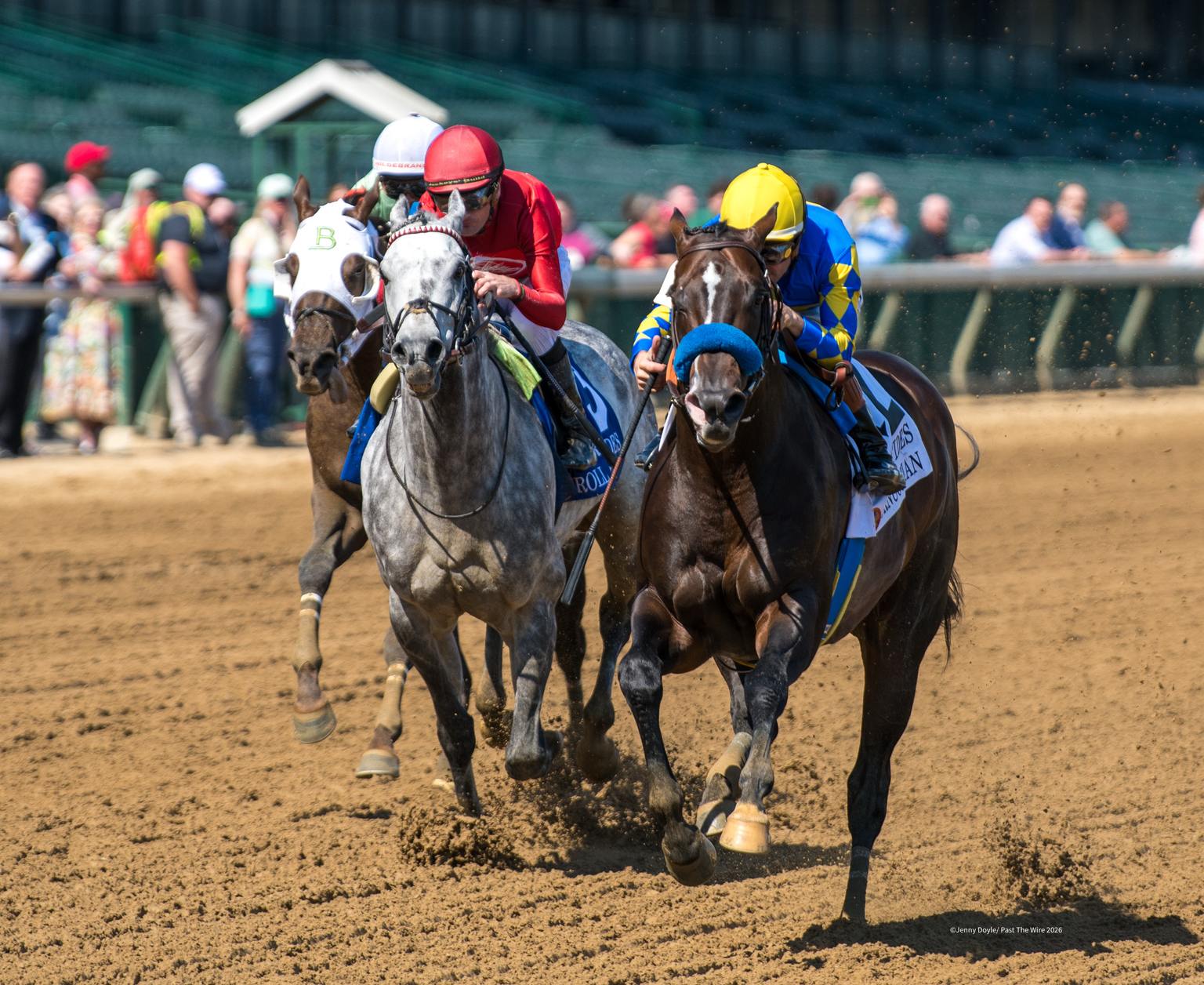
It was difficult to watch Cornucopian pull up injured while making what appeared to be a winning move in the Bing Crosby at Del Mar. A victory would have sent him to the Breeders Cup Sprint, a race his speed, class and ability clearly said he belonged in. My first thought was for the horse, and it remains there. My second reaction was different from much of what I saw across social media. I thought about the people who love and care for him, Bob Baffert, his family, his team, and Tom Ryan.
In full transparency, I have the privilege of calling Bob, his wife Jill, and two of Bob’s sons friends. I have seen them cry over horses. I have watched the pain that follows an empty stall. I have been around their barn enough to know that they eat, breathe and live this sport twenty four hours a day, seven days a week. I have also been around Tom Ryan enough to know that he cares deeply and was as gutted as the rest of us. That disclosure is relevant because readers deserve to know where I stand. It is not an apology for caring about people who care about a horse.
At the time the public record was clear, Cornucopian had been pulled up, transported for radiographs, and was being evaluated by veterinarians. Dr. Jeff Blea, the equine medical director for the California Horse Racing Board, was quoted saying the horse was comfortable and in stable condition while a treatment plan was considered.
That was the confirmed information. It did not stop people from declaring him dead. Posts announcing that he had been euthanized circulated rapidly. At least one was later deleted. The deletion matters because it reveals the difference between reporting and performing the role of a reporter. A journalist verifies, attributes, corrects openly, and accepts responsibility. Someone chasing attention can publish the worst possible outcome, collect the reaction, erase the evidence, and move along as if the people attached to the horse were not reading every word.
No one needed to know first. Everyone needed the information to be right. When the subject is a living animal and the people waiting for a diagnosis love that animal, speculation is not harmless. It is cruelty dressed as urgency.
The verdict that precedes the evidence
The speed of the false reports was disturbing, but the reaction around them was revealing. For some people, an injured horse in the care of Bob Baffert is not first treated as a tragedy. It is treated as confirmation. The horse becomes evidence in a case they decided years ago. Concern gives way to accusation. Grief becomes content. People who describe themselves as good for the game permit or encourage threads built around hatred of one trainer, then call that conduct advocacy for horses.
That is not horse welfare. Horse welfare is consistent. It does not change according to the name on the program. If compassion appears for one barn and contempt appears for another under the same circumstances, the difference is not concern for the horse. The difference is the narrative.
Baffert is the most visible trainer in American racing. His victories are national events, his setbacks become national arguments, and every incident involving his barn receives attention that comparable incidents elsewhere rarely approach. Visibility can justify scrutiny. It cannot justify abandoning proportion, context or accuracy. Scrutiny without comparison is not analysis. It is selection.
What the California record actually says
The most frequently repeated number in this debate came from a Washington Post analysis of California records from 2000 through 2020. It identified seventy four horses that died while in Baffert’s care and divided that total by 8,913 California starts, producing 8.30 deaths per 1,000 starts. Jeff Bonde was calculated at 8.12, Charles Treece at 6.79, and Jerry Hollendorfer at 6.25.2
The number was real within the definition used. The way it has often been repeated is not. It was not a pure racing breakdown rate. The numerator included racing deaths, training deaths, sudden deaths, illness, and other deaths in a trainer’s care, while the denominator was race starts. That is a broad stable mortality measure divided by a racing exposure measure. It can reveal something, but it cannot honestly be presented as if 8.30 horses died in races for every 1,000 starts.
Time also matters. Thirty four of the seventy four deaths attributed to Baffert in that twenty one year analysis occurred during the first six years, from 2000 through 2005. A historical total can describe history. It cannot, by itself, describe current performance after changes in regulation, veterinary review, track safety and barn practice.
More recent California reporting points in a different direction. In May 2023, the Los Angeles Times reported that over the preceding five years Baffert had a fatality rate lower than most California trainers with large stables. That sentence rarely travels as far as the older 8.30 figure, even though it is more relevant to the current claim that Baffert is uniquely or presently the problem.
This does not erase any horse, excuse any death, or declare any rate acceptable. It establishes something narrower and essential. The available California evidence does not support treating Bob Baffert as the singular safety outlier that social media insists he is.
What New York shows, and what it does not
California is not the only jurisdiction with usable public records. The New York State Gaming Commission maintains an incident level Equine Death and Breakdown database that identifies the horse, trainer, track, activity and incident description. A review of that official database from 2021 through July 26, 2026 found ten unique deaths associated with Todd Pletcher in New York, including two racing deaths and eight training deaths. The same review found twenty five associated with Rudy Rodriguez, including ten racing deaths, ten training deaths, and five medical or other deaths. It found one racing death associated with Steve Asmussen in New York during that period.
Those are raw counts within New York, not national totals and not trainer rates. They must not be divided by national starts, and a training death should ideally be measured against workouts or horses in active care rather than race starts. Pletcher, Asmussen and Rodriguez also do not share identical exposure in New York. Any article that ignores those limits would repeat the methodological mistake this article is criticizing.
The counts are still relevant. They establish that fatal incidents involving elite and high volume barns are not unique to Baffert. They also expose an enormous difference in public treatment. Pletcher’s official New York record includes more fatalities in the period examined than the simplified public narrative would lead many racing fans to imagine, yet his name does not routinely convert every injury into a referendum on his morality. That is not an argument to attack Pletcher. He should not receive the treatment Baffert receives. It is an argument that no trainer should be tried by selective arithmetic and viral hostility.
A separate BloodHorse examination of California and New York data for 2020 through 2022 studied eighty three trainers with at least four hundred starts in the state examined. Only nineteen had no racing or training fatalities in that period. Sixty four had at least one.
That is the reality of exposure. A large stable that trains and races many horses accumulates more starts, more workouts, more veterinary events and more opportunities for an incident. Greater exposure makes a larger raw count more likely. It does not automatically produce a higher rate, and it does not prove negligence. The correct questions are how many horses were exposed, how often they raced, how often they worked, what type of death occurred, and how the rate compares with genuinely similar operations.
The level of competition is also part of the context, though it must be stated carefully. Elite barns ask elite horses to perform at elite speed. That fact does not prove that top competition causes a higher fatality rate. It does mean that comparisons should be made among barns with similar populations, schedules, surfaces, jurisdictions and levels of exposure. Comparing an active national stakes barn with a small local stable by raw totals alone is analytically empty.
HISA has the numbers
The Horseracing Integrity and Safety Authority already understands the need for trainer level analysis. In July 2026, HISA stated that it monitors trainer injury and fatality statistics internally but does not make individual trainer statistics public. HISA also said it intends to develop a public dashboard.
That admission is central. The authority charged with national safety has the capacity to test the claims made every day about individual trainers, but the public cannot see the result. The vacuum is filled by old figures, mismatched denominators, selective state records, anonymous certainty, and whichever name generates the greatest reaction.
HISA publishes valuable national measures. Its reported racing fatality rate was 1.23 per 1,000 starts in 2023, 0.90 in 2024, and 1.04 in 2025. For the first quarter of 2026 it reported 0.95 racing fatalities per 1,000 starts. HISA separately reported training fatality rates of 0.50 per 1,000 workouts in 2024, 0.55 in 2025, and 0.67 in the first quarter of 2026.7
The separation matters. Racing fatalities belong over starts. Training fatalities belong over workouts. Sudden and medical deaths require their own category and an exposure measure appropriate to horses in care. One broad total divided by starts may be useful when consistently labeled, but it should never be confused with the racing fatality rate used by HISA.
A credible public trainer dashboard should report racing fatalities, training fatalities, sudden or medical deaths, starts, timed workouts, unique horses in active care, jurisdiction, surface, and the period measured. It should publish the definitions and preserve the distinction between a count and a rate. It should allow comparisons among trainers with sufficient exposure and warn when a sample is too small to support a conclusion.
Transparency would not protect Baffert from facts. It would protect everyone from fiction. If Bob Baffert is an outlier, the numbers will show it. If he is not, the people who built careers implying otherwise will have considerably less to say.
The moral question is consistency
Horse racing cannot demand accuracy from regulators while tolerating recklessness from people who claim to report on it. It cannot condemn misinformation when it harms the sport and celebrate misinformation when it harms a person the crowd has decided to dislike. It cannot claim to care about backstretch workers and families while treating their worst moments as an opportunity for engagement.
There is a moral difference between reporting that a horse was pulled up and reporting that the horse was dead. There is an ethical difference between sharing an official update and repeating an unverified claim. There is a professional difference between correcting a mistake in public and quietly deleting it after the damage has traveled. The desire to be first does not reduce the duty to be right. It increases it.
The same standard belongs in the statistical argument. Every fatality deserves to be counted. Every trainer deserves to be measured by the same definitions. Every numerator deserves the correct denominator. Every time period deserves to be identified. Every comparison deserves enough context to mean what the writer says it means.
This is not a request for softer coverage of Bob Baffert. It is a demand for harder journalism about everyone. Ask difficult questions. Publish complete records. Examine medication cases, veterinary decisions, training patterns, surface conditions, regulatory findings and safety rates. Then apply the same rigor to every powerful barn, every jurisdiction, and every institution that controls the data.
What happened around Cornucopian showed how badly that standard is needed. Before veterinarians had announced an outcome, people announced one for them. Before the facts had settled, the familiar judgment had already arrived. The horse became secondary to the opportunity to punish a name.
My concern remains with Cornucopian and with everyone caring for him. Friendship does not disqualify me from examining the record. It obligates me to disclose the relationship and then get the record right. The same obligation belongs to people who dislike Baffert. Their dislike is also a point of view. It does not become evidence because it is popular.
Denzel Washington once put the problem plainly when discussing the press: the responsibility is to get it right, not merely to be first. That principle is not old fashioned. It is the minimum requirement for anyone who wants the authority that comes with reporting.
The horse was still being evaluated. The verdict was already in. That is not journalism. That is not transparency. And it is not good for the game.
Sources and methodology
1. Paulick Report, July 25, 2026. Reports the Equibase chart and quotes Dr. Jeff Blea stating that Cornucopian was comfortable and stable while awaiting a treatment plan.
2. The Washington Post, June 18, 2021. California record analysis covering 2000 through 2020. The article’s broad death count includes categories beyond racing fatalities.
3. Los Angeles Times, May 29, 2023. Reports that Baffert’s fatality rate over the preceding five years was lower than that of most California trainers with large stables.
4. New York State Gaming Commission Equine Death and Breakdown database. Official incident level data reviewed through July 26, 2026. Records classified by the Commission as EQUINE DEATH were counted. The duplicate Twinkling 24 entries dated July 4 and July 5, 2026 were treated as one incident. Activity classifications are the Commission’s own. These are New York counts, not national totals or rates.
5. BloodHorse, December 18, 2023. Analysis of trainers with at least four hundred starts in California or New York from 2020 through 2022.
6. Thoroughbred Daily News, Ask HISA, July 13, 2026. HISA says individual trainer statistics are monitored internally but are not currently public and describes plans for a public dashboard.
7. HISA first quarter metrics report, 2026. National racing and training fatality rates, with historical comparisons reported by HISA.
Editorial note: This commentary distinguishes verified official information from unverified social media claims. Trainer counts are described only within the jurisdiction and period covered. No state fatality count is divided by a national starts total, and racing and training exposure measures are not treated as interchangeable.
This is the only class in Journalism I have ever taken. JS