
 Brought to you by AmWager
The math simply doesn’t add up. Why would our most powerful institutions sit on record reserves while the industry faces a structural hurricane? If leadership is measured by its care for the most vulnerable participants, the current view from the top is failing. Simplicity is the essence of intelligence, and since coincidences are for romance novels, we have to look for the structural reason behind this unprecedented hoarding of capital.
We’ve heard about “rainy day reserves” from the sport’s most powerful nonprofit institution — The Jockey Club and we know the Breeders’ Cup has even more. Stockpiles of cash would be a fair characterization.
Meanwhile:
- Foal crops are down.
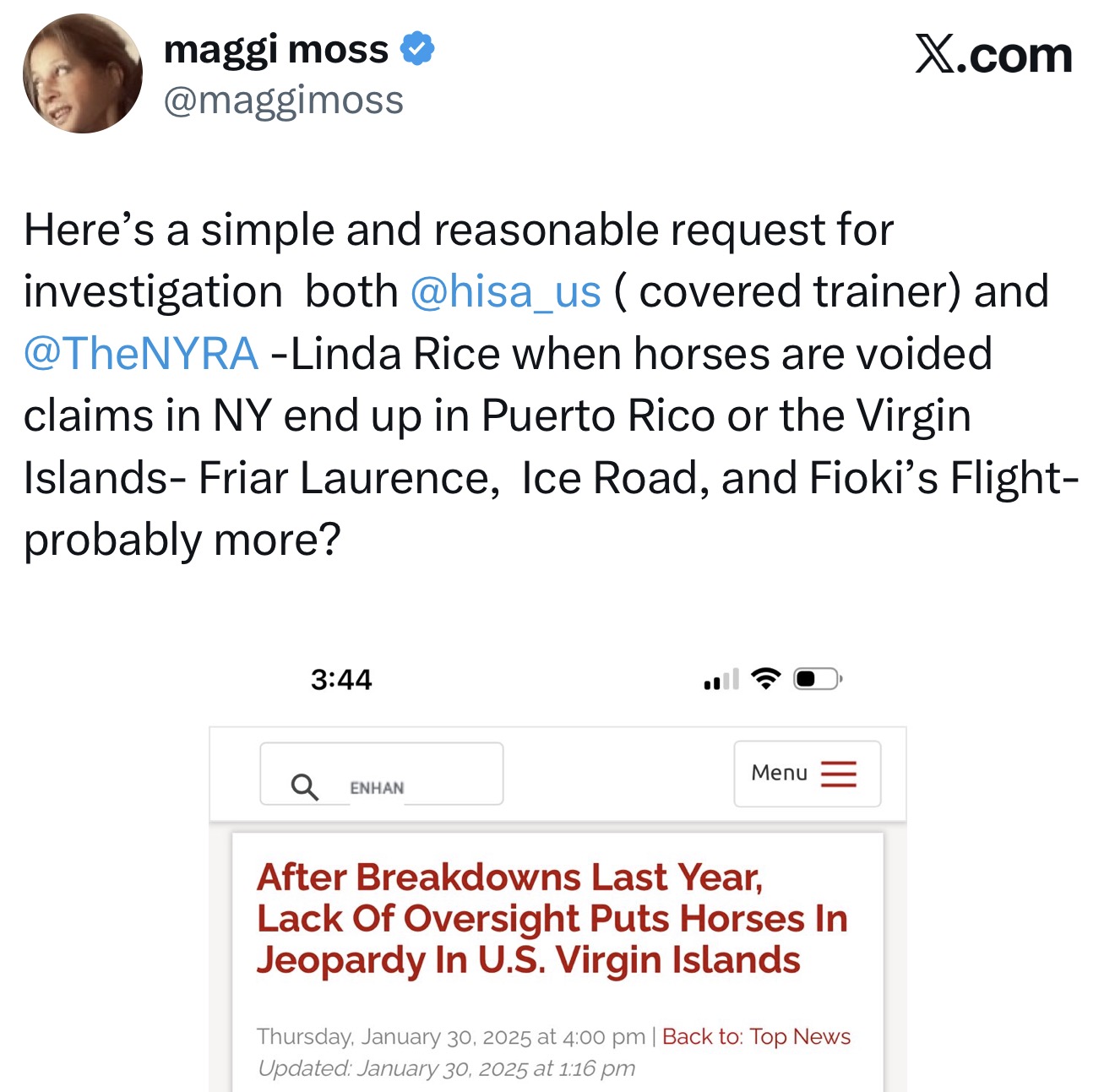
- Horses are winding up in horrific places and situations.
- Tracks are disappearing.
- Aftercare groups are fundraising for hay.
- Backstretch infrastructure is deteriorating.
- Owners are squeezed at every level beneath the elite tier.
- CAW’s are simultaneously sustaining the sport and cannibalizing the pools.
That’s not drizzle. That’s structural pressure. That’s a Cat 5 hurricane. So the question isn’t whether reserves are legal. They are. The question is whether the way these institutions are structured makes them stewards of the sport — or institutions engineered to remain insulated regardless of what happens to the rest of it.
The Breeders’ Cup: Structure Before Sentiment
Breeders’ Cup Limited is not a public charity. It is a 501(c)(6) business league, headquartered in Lexington, Kentucky, but legally domiciled in New York. That matters. When most people hear “nonprofit,” they think “charity.” A 501(c)(6) is not that.
Its governance and asset treatment are defined by:
- Its certificate of incorporation
- Its bylaws
- New York not-for-profit corporate law
And its bylaws are not generic. They define membership classes tied to capital certificates, including “Founding Members” associated with specific capital thresholds. That is not speculation. That is structure. Here is the fair, necessary question:In the event of a wind-down or dissolution, what do the governing documents say about distribution of net assets — and how do capital certificate holders factor into that?
Under New York law, as I understand it, nonprofits cannot simply distribute profits as dividends to members. There are private inurement prohibitions and formal dissolution procedures. But here is the point that cannot be dismissed:
In a 501(c)(6), asset destination is governed by corporate documents and state law — not by public assumption.
And when recent filings show roughly $90+ million in net assets and over $110 million in total assets, that governance detail becomes relevant. Not because wrongdoing is proven. Because transparency at that scale is required.
The Fee Structure That Builds the Reserve
You don’t need rhetoric when the paperwork speaks. The official Breeders’ Cup pre-entry documentation states:
“Pre-entry and entry fees will not be added to purses but will become the property of BCL.”
In the Classic, that equals:
- $75,000 pre-entry
- $75,000 entry
- $150,000 per starter
Those funds do not enhance the purse pool for the competitors who run. They accrue to the organization. That is policy. That is documented. It’s not illegal. Does it contribute to institutional liquidity while everyday participants struggle elsewhere in the ecosystem? Yes. That’s not conspiracy. That’s math.
Governance Concentration: The Same Names, The Same Rooms
Publicly listed leadership across Breeders’ Cup and The Jockey Club includes prominent figures such as:
- Barbara Banke
- William S. Farish Jr.
- Elliott Walden
- Stuart S. Janney III
These individuals represent major breeding and commercial stallion operations with enormous influence in the sport. Many have served in leadership roles across multiple institutions — Breeders’ Cup, The Jockey Club, and related market entities. Overlap is not illegality. It does concentrate influence.
When championship governance, registry authority, marketplace power, and event hosting circulate within a tight circle, the sport has a right to ask:
- What are the conflict-of-interest safeguards?
- What are the recusal policies?
- How are related-party transactions reviewed?
- Who ultimately benefits from fee structures and reserve growth?
Those are governance questions. Serious ones.
The Jockey Club: Registry, Data, and Regulatory Proximity
If the Breeders’ Cup is the championship economy, The Jockey Club is the registry infrastructure. It operates as a 501(c)(5) agricultural organization and reports tens of millions in assets. It also has ownership interests in Equibase Company LLC, described as a partnership between subsidiaries of The Jockey Club and the Thoroughbred Racing Associations. That means the sport’s data backbone flows through entities connected to the same governance ecosystem. Illegal, no, powerful, absolutely. Layer in another documented fact: Leadership at Horseracing Integrity and Safety Authority publicly acknowledged receiving start-up loans from The Jockey Club, Breeders’ Cup, and NTRA to fund early operations. That creates a legitimate question of perception:
How independent can a regulator appear when its early operating capital came from the institutions it indirectly intersects with?
No accusation. Just structural reality.
The Keeneland Axis
Then there is Keeneland. The Breeders’ Cup returns to Keeneland again in 2026 — the fourth time since 2015. Keeneland is simultaneously undertaking a major capital expansion project approaching $90+ million. Capital investment is not a crime. But when leadership overlaps exist between Breeders’ Cup governance and Keeneland trusteeship, governance diligence matters. When the championship, the marketplace, and the registry share overlapping influence networks, transparency must be airtight. I don’t believe the “trust us” model is appropriate. The model has to be transparent and demonstrative.
The “Exit Strategy” — Framed Correctly
Let’s remove the hyperbole and say it precisely. I am not alleging:
- A secret liquidation dividend.
- An imminent payout.
- A criminal scheme.
What I am stating is this:
- These institutions are structured to remain financially liquid.
- Their reserves are substantial relative to the industry’s situation.
- Their governance documents — not public rhetoric — determine what happens in extreme scenarios.
- The broader racing community does not have clear, accessible disclosure regarding those mechanics.
That asymmetry fuels distrust. If racing thrives, these institutions remain powerful and well-funded. If racing contracts dramatically, they remain among the most financially insulated entities in the ecosystem. That is not proof of malice. It is proof of insulation. One could certainly argue it is good business. More than one thing can be true at the same time, but we are talking about the pillars and leaders of an industry in trouble and horses who need help. That can’t be lost in business practices or a board room.
What Would End This Debate Immediately
If the goal is stewardship, here is the blueprint:
- Publish a clear reserve policy with defined target ranges.
- Publish dissolution asset distribution language in plain English.
- Publish a detailed related-party transaction summary.
- Disclose formal recusal practices for overlapping board roles.
- Commit a defined percentage of reserve growth to industry stabilization and aftercare.
That is governance best practice and also good business.
Final Word
Nobody is alleging illegality. But legality is not the same as leadership. When nearly $200 million combined sits in institutional reserves while the sport beneath it struggles, people will ask questions. And they should. Louis Masry is still waiting for answers. Mike Repole and Pat Cummings are waiting for answers, we have an OPEN LETTER to The Jockey CLUB unanswered, and an 18 month mandate which is clearly a big bet against.
If you are truly guardians of the sport, transparency is your ally. If you are simply built to survive regardless of the sport’s trajectory, silence becomes telling. Rainy day fund? Maybe. But in a Cat 5, what matters isn’t who has the strongest roof, though that helps them. It’s who opens the doors.
The Thoroughbred Stewardship and Transparency Checklist
A 2026 Governance Benchmark for The Jockey Club, Breeders’ Cup, and Allied Institutions
This checklist defines the professional delta between “institutional survival” and “industry leadership.” Any organization claiming to be a guardian of the sport should be able to check every box.
I. Financial & Reserve Transparency
- [ ] Reserve Policy Disclosure: Publish a formal “Reserve and Investment Policy” that defines the target liquidity range and the specific “triggers” (e.g., industry foal crop thresholds or emergency track closures) that would deploy those funds into the ecosystem.
- [ ] Dissolution Provisions: Provide plain-English summaries of the Articles of Incorporation and Bylaws regarding the distribution of net assets in the event of a wind-down.
- Specifically for the Breeders’ Cup: Clarify the status and payout priority of “Capital Certificates” versus industry-facing missions (e.g., aftercare).
- [ ] Entry Fee Allocation: Disclose the percentage of pre-entry and entry fees (e.g., the “Scratch Tax”) that remains with the organization versus the amount returned to the purse pool or horsemen’s welfare.
II. Governance & Interlocking Directorates
- [ ] Conflict-of-Interest (COI) Registry: Maintain a publicly accessible (or member-accessible) registry of all outside board seats and commercial interests held by Directors and Stewards.
- [ ] Recusal Protocols: Formalize and disclose the policy for when a Director must recuse themselves from votes regarding site selection (e.g., BC to Keeneland), regulatory lending (e.g., TJC to HISA), or commercial data contracts.
- [ ] Term Limits and Diversity: Disclose the current tenure of all board members and a formal “Succession Plan” designed to bring diverse industry perspectives (small owners, trainers, backstretch stakeholders) into the closed-loop governance cycle.
III. Related-Party & Subsidiary Oversight
- [ ] Subsidiary Financial Reporting: Provide consolidated financial statements that show the flow of “nonprofit” registry revenue into “for-profit” data subsidiaries (e.g., Equibase).
- [ ] Professional Service Fee Audit: Disclose a breakdown of “Professional Fees” that exceed a defined threshold (e.g., $100k) to ensure they are not being directed to entities with personal or commercial ties to the Board of Stewards.
- [ ] Loan Priority Disclosure: Publish the repayment terms and security interest of all industry-facing loans (e.g., HISA startup capital) to clarify where the institution sits in the “creditor line” relative to other stakeholders.
IV. Mission-Aligned Reinvestment
- [ ] Direct Aftercare Commitment: Dedicate a fixed percentage (e.g., 10%) of annual net reserve growth to accredited Thoroughbred aftercare and backstretch health programs, independent of “marketing” or “promotional” spending.
- [ ] Public Accountability Forums: Host at least one annual “Town Hall” for industry participants (owners, breeders, and fans) to review the organization’s financial health and strategic direction.
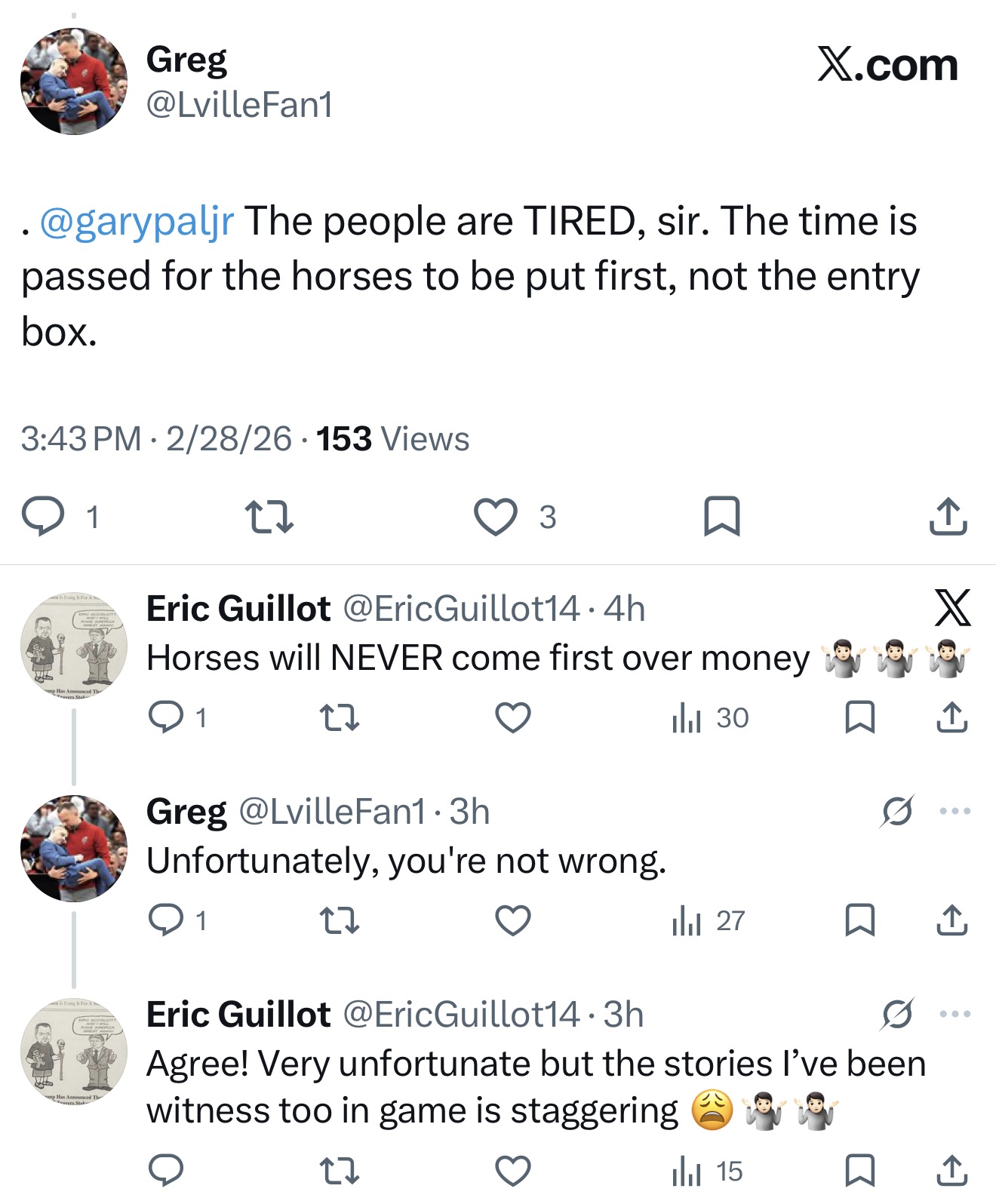
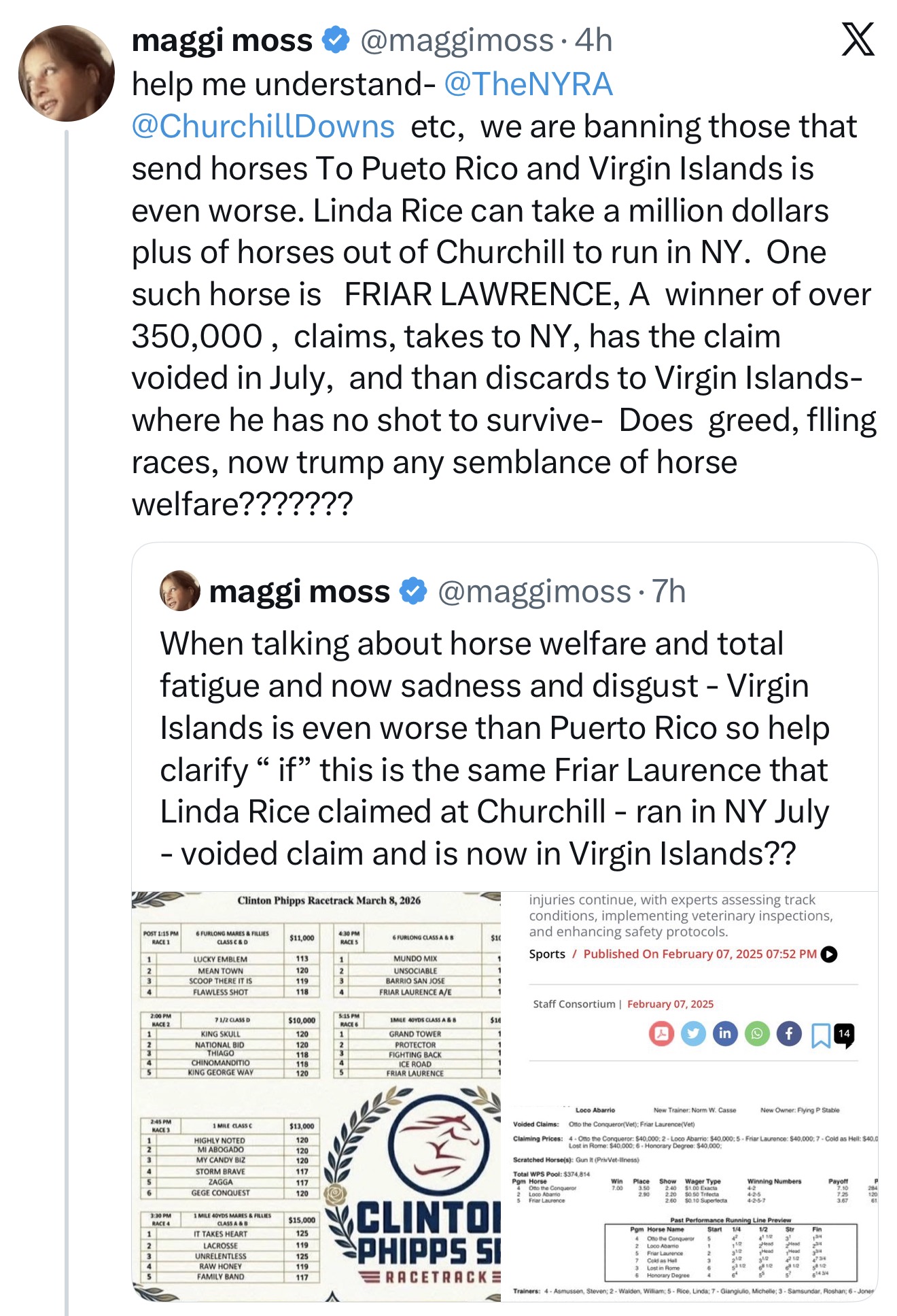
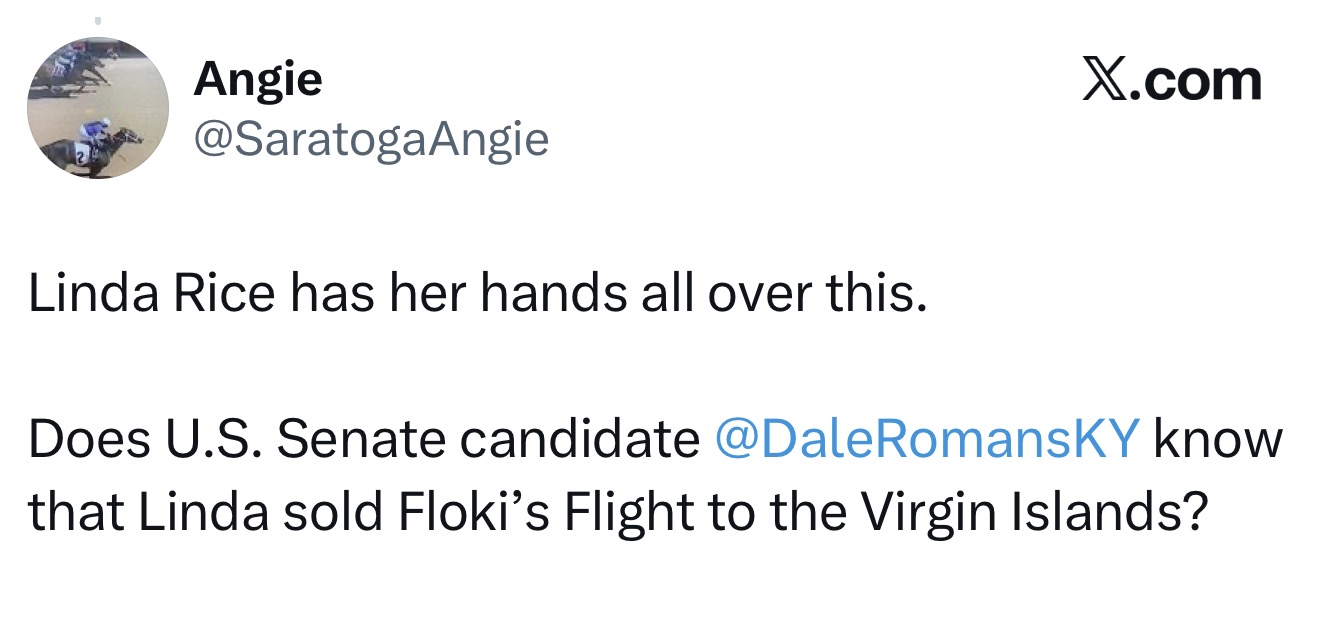
This should not be the horse racing theme across social media the weekend of The Fountain of Youth and The Rebel! If the horses come first, it is time to prove it:
Maybe You and Sosa Know Something I Don’t Know: