

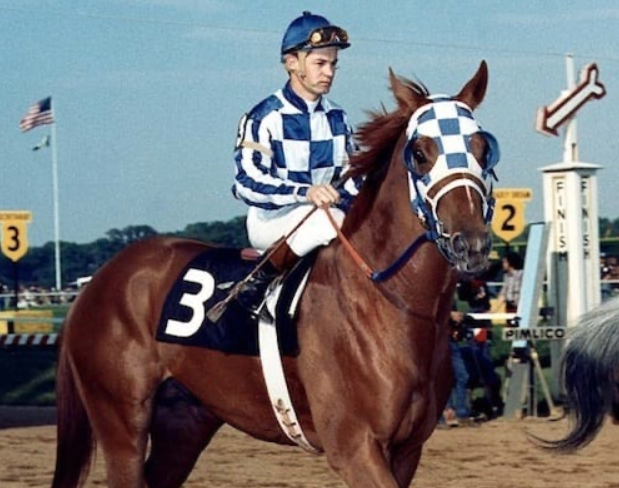
Turcotte and Secretariat at the 1973 Preakness at Pimlico Race Course. (Jim McCue)
Nick Costa
As we approach the birthdays of two of racing’s most legendary champions — Man o’ War on March 29 and Secretariat on March 30 — it’s the perfect time to revisit a debate that has fascinated fans for generations.
When it comes to horse racing, few debates spark more passion than this one: Man o’ War or Secretariat? Both chestnut giants carried the nickname “Big Red,” each dominating their era in unforgettable fashion. Man o’ War, the original Big Red, reigned supreme in the early 20th century, so dominant that his legacy still echoes more than a century later. Decades later, Secretariat exploded onto the scene, shattering records and redefining greatness with his breathtaking 1973 Triple Crown.
Two horses, two eras, one nickname—and one timeless question: if they met at their peak, who would win? While we’ll never know for certain, exploring their stories, their stats, and their enduring impact reveals why this debate continues to captivate racing fans around the world.
Man o’ War: The Original Big Red
Foaled in 1917, Man o’ War raced just 21 times, winning 20 of them. His only defeat came under chaotic circumstances at the start. Many competitors simply refused to run against him, and those who did quickly realized his dominance was unmatched. Victory margins often stretched by double digits, showcasing not only his raw power but also his intelligence and tactical brilliance. Man o’ War became more than a champion; he was a national icon in post–World War I America. His bloodline continues to shape thoroughbred racing to this day, cementing him as a patriarch of the sport.
Secretariat: The Record Breaker
More than 50 years later, Secretariat emerged as a colt with both brilliance and charisma. What set him apart wasn’t just winning the Triple Crown—it was how he did it. His Belmont Stakes performance, a staggering 31-length victory, remains one of the most iconic moments in racing history. Secretariat still holds record times in all three Triple Crown races, a testament to his extraordinary speed and stamina. If Man o’ War symbolized dominance, Secretariat was the very embodiment of perfection.
Stats and Records
| Man o’ War | Secretariat | |
| Foaled | 1917 | 1970 |
| Career Starts / Wins | 21 / 20 | 21 / 16 |
| Seconds / Thirds | 1 / 0 | 3 / 1 |
| Triple Crown / Major Wins | Preakness, Belmont, numerous major handicaps | Triple Crown 1973, Belmont by 31 lengths |
| Distance Preference | 1–1½ miles, highly versatile | 1¼–1½ miles |
| Peak Speed | Slightly slower, but explosive acceleration | Record-breaking times, stride ~28 ft |
| Dominance | Nearly unbeaten, dominated every peer | Unbeaten in major races, records still stand |
| Temperament | Intelligent, tactical | Competitive, fiery |
| Training Era | Early 20th century, heavier tracks | Modern tracks, veterinary care |
| Cultural Impact | Symbol of dominance, influenced breeding | Icon of speed, media sensation |
The Lasting Debate
Comparing these two legends isn’t about declaring one “better”—it’s about appreciating what made each extraordinary. Man o’ War set the foundation for greatness, blending raw power with tactical brilliance. Secretariat redefined what speed and dominance could look like, achieving feats that still inspire awe.
Ask 100 racing fans who would win in a hypothetical head-to-head, and the answers would be split down the middle. Some insist Man o’ War’s intensity would carry him across the finish line. Others argue Secretariat’s stride, speed, and Triple Crown dominance make him unbeatable. What’s certain is that both earned the nickname “Big Red,” and both remain benchmarks for excellence in thoroughbred racing.
The Verdict
And so, the debate lives on. Who would cross the finish line first if they raced today — Big Red, Man o’ War or Big Red, Secretariat? While the winner may forever be imaginary, the admiration—and the conversation—never ends.