

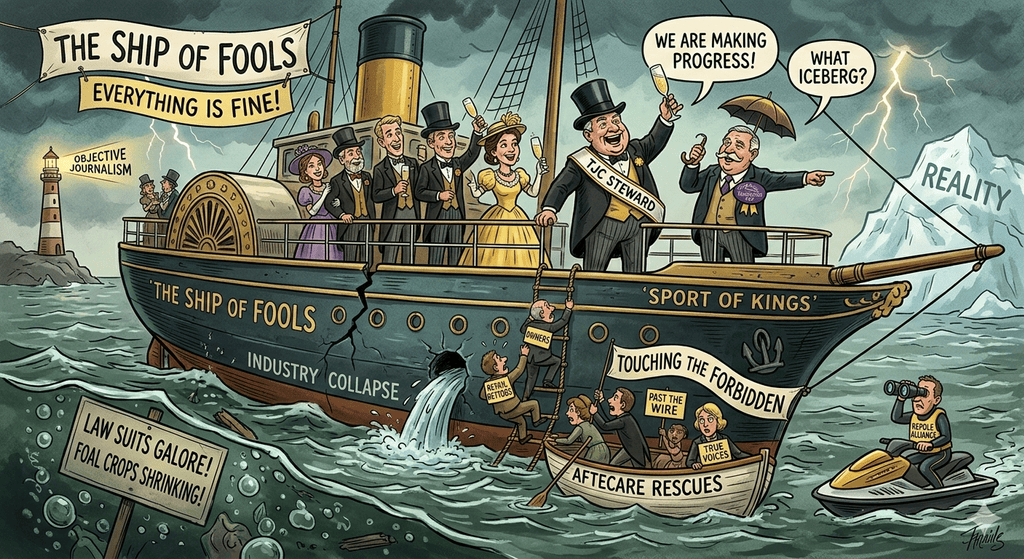
How the Sport of Kings became a Ship of Fools — captained by lawyers, crewed by bureaucrats, and sinking to the theme song of a PR firm’s press release
Somebody had to do a Horse Racing State of the Non Union
There is a photograph — metaphorical, but vivid — that perfectly captures American Thoroughbred racing in March of 2026. In it, a magnificent tall ship is listed twenty degrees to starboard, fire visible belowdecks, the bow pointed directly at a reef clearly marked on every chart. On the bridge, a group of men in blazers are toasting each other with champagne flutes, assuring the passengers through a gold-plated intercom that the view from the poop deck has never been better. Below them, the bilge pumps are being manned by lawyers. The lifeboats have been sold to a hedge fund that uses them to bet against the tide. And somewhere in the hold, there is a stack of press releases, freshly printed, reading: “Racing’s Future Has Never Been Brighter.”
Before we get to far, can someone please tell us who Westlake Stables is? It seems nobody wants to talk to them.
Welcome aboard. Mind the subpoenas.
⚖ The Docket, Your Honor
Let us begin, as all truly Shakespearean disasters must, with the lawsuits. Not a lawsuit. Lawsuits. Plural. An armada of litigation so vast you could almost call it a scheduling problem, except that would imply someone in this sport actually manages schedules competently, which, as we will get to, they demonstrably do not. We can’t as an industry stagger post times of stake races on a Saturday, the bar is low.
First comes Dickey v. Stronach et al — filed October 24, 2025 in the Eastern District of New York, and already well on its way to becoming the most illuminating document in the history of pari-mutuel wagering. Ryan Dickey, a Colorado man who bet roughly one hundred dollars a week on horse racing for the better part of two decades before rage-quitting the whole enterprise, has accused Churchill Downs, The Stronach Group, NYRA, AmTote, United Tote, Elite Turf Club, and Velocity Wagering of running what the complaint calls, with a certain bracing directness, a rigged system. The legal framework invoked is RICO — the same statute historically reserved for organized crime. One presumes the irony was intentional.
The thrust of the case is that Computer Assisted Wagering players — the algorithmic whales who scan pool movements in real time, place batched bets in the final seconds before post, collect volume-based rebates unavailable to any normal human with a TwinSpires account, and effectively play an entirely different game than the retail bettor — have been given structural advantages that amount to, in Dickey’s framing, “no-risk, no-loss wagering opportunities.” The suit estimates the affected wagering approaches nearly four billion dollars annually. Stronach, in its response, compared CAW rebates to airline miles. One imagines the retail horseplayer, staring at a pool that moved three ticks in the last ninety seconds and cost him a nickel on the dollar in real time, finding that analogy somewhat incomplete.
“Cash-strapped racetracks are selling out everyday bettors to whales who use algorithms to wager huge sums at friendlier odds. It’s a rigged system designed for the rich to get richer.”
— The Guardian, quoted in the Dickey complaint
The defendants responded to Dickey’s push for discovery — the process by which he would get access to the actual pari-mutuel settlement records that would prove or disprove his case — by telling the court that producing those records would be an enormous hardship, riddled with trade secrets, and potentially very damaging to their reputations. Judge Joan Azrack, in late February, halted discovery for the time being. The tracks celebrated this as a procedural victory. The casual horseplayer celebrated it as confirmation that whatever is in those records is apparently worth moving heaven, earth, and a federal judge to conceal.
The CAW case hasn’t even warmed up. And already it tells you everything you need to know about whose interests this sport has been built to protect.
💸 A Man Who Doesn’t Pay His Bills
Meanwhile, on another front of the ongoing war that is American racing’s governance structure, we have Churchill Downs, Inc. — the same Churchill Downs that owns one of the CAW platforms named in the Dickey suit — refusing to pay a single cent of its 2025 HISA assessment fees. Not a partial payment. Not a disputed installment. Not one cent, as HISA’s February 18 notice of hearing stated with a kind of prose exhaustion that suggested even federal regulators have begun to despair.
HISA, which is tasked with the safety and anti-doping oversight of Thoroughbred racing nationally, billed Churchill Downs over six million dollars for 2025 under the approved formula. Churchill, finding this amount inconvenient, chose to pay using a formula that hasn’t been officially adopted yet — that is, the formula they themselves advocated for — which produced a lower number. And then they paid that lower number not at all, either. CDI was the only racetrack company under HISA’s jurisdiction that paid the Authority nothing in 2025. Zero. A goose egg. The kind of accounting strategy that, in any other regulated industry, would produce consequences one does not recover from quickly.
HISA CEO Lisa Lazarus, to her credit, did not mince words, describing CDI’s conduct as “freeloading.” CDI responded by suing HISA, calling the fees “illegally imposed,” and adding that HISA’s enforcement threats represented “a troubling pattern of overreach.” This from a company that posted record fourth-quarter revenues of $665.9 million for 2025. They don’t lack the money. They simply don’t feel like paying. There is something instructive about that.
As of this writing — March 18, 2026 — HISA has ordered Churchill to pay up or lose its ability to simulcast races starting March 26. Turfway Park races March 26 through 28. The Kentucky Derby is May 3. If you think the industry’s most lucrative single afternoon of wagering is actually going to be blocked by a regulatory fee dispute, you have more faith in institutional resolve than this publication has earned the right to express. But the threat is real. The deadline is real. And the fact that this is even a conversation — that racing’s most famous event is notionally endangered by a billing dispute between its own regulatory authority and its own most powerful track — is its own kind of summary statement about the sport’s condition.
Let’s not talk about HISA loans from the Breeders’ Cup and how much they pay. Not now anyway.
⚖ The Racing Litigation Scoreboard — March 2026
- Dickey v. Stronach et al: RICO class action targeting CAW platforms. Discovery halted Feb. 20.
- CDI v. HISA: Churchill suing over fee methodology. Case in Western Kentucky federal court.
- HISA v. CDI: HISA board panel orders payment by March 26 or simulcasting revoked.
- Repole v. The Industry: Antitrust suit in preparation targeting TJC, Breeders’ Cup, NTRA, TOBA. “Very, very nasty,” Repole promises.
- CDI v. Kalshi/Prediction Markets: Churchill fighting prediction market operators over Kentucky Derby intellectual property.
🔥 The Man with a Bullhorn and a Point
Into this particular clown car has stepped Mike Repole, no clown, — owner of fast horses and roughly a billion dollars worth of impatience — who has spent the past two-and-a-half years doing the one thing the Sport of Kings has never been able to tolerate: saying out loud, on social media, in press conferences, and soon in legal filings, what everyone on the backstretch whispers but no one with a seat at the table has ever been willing to print.
Repole has called The Jockey Club “a blueblood scam.” He has described the sport’s leadership as “some of the worst in sports.” He has referred to the Breeders’ Cup schedulers, in a moment of characteristic restraint, as “stupid people.” He announced in January 2026 that he is preparing a wide-ranging antitrust lawsuit targeting The Jockey Club, the Breeders’ Cup, the NTRA, and TOBA — comparing his forthcoming litigation to Michael Jordan’s antitrust case against NASCAR and promising it will get “very, very nasty.” We believe him.
The Jockey Club, after two and a half years of refusing to publicly engage, finally responded on January 27 (they should have stuck with the original plan) with an open letter that its own sympathizers described as “ill-advised, weak, non-substantive and overtly gaslighting.” The letter defended the organization’s $112 million in industry contributions over fifteen years — a number that sounds impressive until you consider the financial reserves those same filings reveal, and until you ask the aftercare organizations what their waiting lists look like. It disputed Repole’s characterization of the foal crop crisis by listing the complex forces behind it. It praised HISA. It pointed to progress. It was, in the memorable phrase of one letter-to-the-editor writer, the organizational equivalent of fiddling while Rome burns.
What The Jockey Club could not dispute — and carefully did not attempt to — was the central arithmetic. The North American Thoroughbred foal crop peaked at 51,296 in 1986. The projected 2026 foal crop is 17,000. That is not a decline. That is a collapse that happened in slow motion over four decades while the same institutional voices told us, every single year, that we were making progress and the future had never looked brighter. The Titanic also made great time before the iceberg.
“The same people are controlling the entire sport. Isn’t that a conflict of interest? Isn’t that a matter of antitrust?”
— Mike Repole, January 2026
🏥 HISA: Doing Good Work, Chasing Grains of Sand
One must be careful here not to throw out the entire institution with the billing dispute. HISA, conceptually, is correct. The sport needed national uniformity. The patchwork of fifty state racing commissions produced exactly the regulatory chaos one would expect from fifty separate fiefdoms, each with their own definitions of what substances were permissible, their own testing labs of varying quality, and their own stewards of varying attentiveness. Some of those stewards, it should be noted, appear to have missed entire careers’ worth of racing incidents. Mr. Magoo had sharper optics.
But here is the paradox that the racing industry has never been able to resolve: HISA is chasing grains of sand on an infinite beach with its hands out. It is underfunded relative to the scope of its mandate, engaged in billing wars with the sport’s most powerful company, and producing fatality statistics that, while improved in aggregate, still revealed a grim truth when Churchill’s own numbers were examined: the fatality rate at Churchill’s tracks dropped to 0.88 per 1,000 starts in 2024, when they cooperated with HISA. In 2025, when the relationship soured over fees, the rate climbed back to 1.77. Lisa Lazarus noted carefully that she was not necessarily saying the two were causally linked. She didn’t have to. The numbers said it.
Meanwhile the sport’s most sophisticated cheaters — the ones who understand that the testing window, the biological passport, and the international marketplace for controlled substances represent a three-dimensional puzzle that a well-funded operation can navigate quite effectively — continue to operate with a confidence that suggests they are not losing sleep over the regulatory environment. HISA’s investigators are diligent. They are also, relative to the problem they are solving, adequately resourced the way a garden hose is adequate for a refinery fire.
🎪 The Championship That Isn’t, and Other Marketing Fictions
While all of the above unfolds, the sport’s promotional apparatus has been busy. There are handicapping contests being marketed with the kind of grandiosity once reserved for sovereign nation treaties. There are press releases from The Jockey Club and TAA arriving with the regularity of tide tables, informing us of progress and partnership and forward momentum. There is the Paulick Report — a publication that has done genuine work in this sport — which has lately developed a curious habit of publishing responses to arguments that Past The Wire made first, without precisely crediting that origin, in a way that functions as a kind of genteel institutional ventriloquism. We note this not with bitterness but with the detached professional amusement of a publication that has learned to recognize the difference between journalism and managed narrative.
Owners are leaving. Not the Mike Repoles — the wealthy participants with enough capital to absorb losses and enough ego to enjoy a fight. The mid-level owners. The partnerships. The people who came into the sport because they loved the horses and believed someone was minding the store, and who discovered that the store has been converted into a derivative instrument and the horses are an afterthought to the handle number. Trainers are retiring. Jockeys are retiring. The ranks of working veterinarians willing to build a practice around Thoroughbred racing are thinning in ways that the industry’s official communications have not seen fit to address with any particular urgency.
The aftercare organizations are doing extraordinary work under conditions that can only be described as triage. The rescues — the small, unglamorous operations that take the horses no one else will take and do it on fundraising budgets that wouldn’t cover a week of entry fees at a graded stakes track — are running on fumes, faith, and the kind of determination that institutional racing cannot manufacture because institutional racing does not actually feel anything. At the top of the sport, in those gleaming boardrooms and those tastefully appointed Lexington offices, there are reserves and endowments and investment portfolios. At the bottom, where the horses end up when their racing career is finished and no one needs them anymore, there are people working three jobs and sleeping in their trucks to make sure an animal doesn’t go to slaughter.
The Titanic also made great time. Right up until it didn’t.
✉ A Note on Declined Invitations
Past The Wire extended invitations to both The Jockey Club and the Breeders’ Cup to appear on Past The Wire TV to discuss their financial structures, reserve philosophies, and governance priorities. Both declined. The Breeders’ Cup, sitting on what our reporting has documented as a substantial and growing investment reserve while direct grants to the industry remain comparatively modest, apparently finds the questions less interesting than we do. The Jockey Club, having declined our invitation and subsequently issued a public letter defending itself from a different questioner, apparently prefers the questions it writes for itself.
The invitation remains open. It will remain open. Because in this sport, in this moment, transparency is not a courtesy. It is a moral obligation. Organizations that claim to steward a sport in the public interest, that file as nonprofits and enjoy the tax architecture that comes with that designation, that collect fees from breeders and bettors and horsemen and then choose their own forums and their own terms of engagement — those organizations owe the people who fund them something more than a press release.
They owe them an honest accounting. They owe them a real conversation. They owe them the respect of sitting across from someone who has actually read the 990 filings and is not there to congratulate them for their service.
Strike Three — And You’re Still Not Out
And then, just as this piece was going to press, came the document that may serve as the definitive epitaph for The Jockey Club’s remaining credibility with its own constituency. Aron Wellman of Eclipse Thoroughbred Partners — a man who has sat at the tables, partnered with the principals, and maintained relationships on every side of this debate — published what he is calling “Strike 3.” It is worth reading in full, because it describes something far more damning than any outside critic could manufacture: the view from inside the room.
Wellman accepted an invitation to meet with two Jockey Club Stewards and President Jim Gagliano. He came in good faith, with real ideas, asking real questions. He came out, by his own account, more unsettled than he went in. His ideas were met with explanations of why they couldn’t be done. His pointed observation — that outgoing Chairman Stuart Janney III, who conducted a complete dispersal of his breeding operation at Keeneland in November 2024 while still serving as Chairman, arguably forfeited his moral authority to steward an industry he was quietly exiting — was dismissed by The Jockey Club representatives as “too personal” and “unfair.” Wellman’s verdict on that exchange was characteristically precise: it made the cultural stagnation “black and white.” Before leaving, Wellman urged The Jockey Club to re-engage with Mike Repole and avoid the litigation that would harm everyone. His plea, he writes, was met with resistance, if not outright refusal.
Wellman’s conclusion deserves to be quoted in its plainest terms: “Call Mike whatever you want. He is not wrong. I now understand, firsthand.” The Kentucky Legislature has now added its own voice, inserting language into HB 904 warning The Jockey Club to stay out of policy debates like the mare cap — for the second time in five years. Pat Cummings and the National Thoroughbred Alliance are mobilizing. The lawsuit is coming. And the organization at the center of all of it sat across the table from one of its own, heard the alarm bells ringing directly into its ears, and apparently could not locate the volume control.
There is a word for an institution that mistakes the patience of its stakeholders for approval, that interprets the silence of the majority as consent, that greets every reasonable critic with a defensive posture and a communications strategy rather than genuine introspection. The word is not “reformable.” Not yet, anyway. Not from the inside. Aron Wellman tried the inside. He is now, in his own careful language, convinced that a more aggressive option may be the only path left. When the diplomats put down their briefcases, the lawyers tend to pick theirs up. The Jockey Club had the chance to change that calculus. They apparently passed.
⚓ The View From The Crow’s Nest
Here is the honest, unfunny truth buried beneath all of the dark humor: horse racing in America is experiencing a genuine civilizational crisis, and the people positioned to address it are more interested in litigation strategy than leadership, more comfortable with institutional self-preservation than institutional self-examination, and more fluent in the language of managed optics than honest reckoning.
The foal crop is at 17,000 and falling. The bettors are leaving — not because they are bored with the sport, but because they have correctly identified that the game being marketed to them is not the game being played on the other side of the tote board. The horses who can’t race anymore are waiting for aftercare slots that don’t exist in sufficient numbers because the institutions with the financial capacity to change that math have determined that it is someone else’s problem. The lawsuits are multiplying because the industry chose silence over transparency for long enough that the only conversations left are the ones that happen in federal court, on the record, under oath.
This is what a Ship of Fools looks like from the crow’s nest. Not a vessel captained by evil people — some of them may not be evil, many of them may genuinely love the sport — but a vessel captained by people who have confused institutional survival with institutional purpose. Who have mistaken the map for the territory. Who have read so many of their own press releases that they have begun to believe them.
The iceberg is clearly visible. We have been pointing at it for some time.
The champagne glasses are still raised on the bridge.
There is one final thought worth leaving on the bar. The Jockey Club reminds me of the bartender who steals from the register so long and so casually that he genuinely forgets he is doing anything wrong. Or the bully who takes the smaller kid’s lunch money every single day until the taking itself feels like a natural order of things — a transaction, not a crime. The danger of institutional power held too long without accountability is not that it turns people evil. It is that it turns the wrong into the unremarkable. Into policy. Into tradition. Into a press release about progress. They are not twirling mustaches in that boardroom. They likely believe, with some sincerity, that they are the stewards this sport deserves. That may be the most unsettling part of all. Because you cannot reform a man who has forgotten he needs reforming. You cannot reason with an institution that has mistaken its own comfort for the industry’s health for so long that the two feel, to them, like the same thing. The lunch money is gone. Has been for years. And they are still surprised anyone is asking about it.
What’s Going On:



GREAT column Jon!
Thank you!