

I have always loved a good caper. The more elaborate, the more moving parts, the more angles and nuances, the better. When it involves my game, horse racing, it becomes all the more intriguing. I want to know how it was conceived, who was involved, who knew what, where the money went, what was supposed to happen, what actually happened, and how the people entrusted with protecting the integrity of the game managed to miss what someone else had already figured out. A good racetrack caper is rarely just about what happened. The more interesting story is almost always how it was allowed to happen.
The alleged Venezuelan betting coup that played out across Saratoga and Monmouth Park has brought those questions back into the conversation. So has the Marshall Gramm saga and the allegations surrounding leaked past performances. They are separate matters, and the allegations remain allegations, but both have reminded us how quickly racing’s assurances about integrity, transparency and safeguards can begin to look different when the right people possess information the rest of the betting public does not.
Racing has a habit of reacting to these episodes as though something unprecedented has occurred, as though someone suddenly discovered that a sport built around money, competition and confidential information might attract people willing to exploit it. Anyone who has spent enough time around racetracks knows better. Safeguards have been failing for about as long as horses have been racing and people have been betting on them.
We have been down some of these roads before. We have looked at the Milkman. We have looked at the Brain gaming The Travers. We have looked at the Kinahan Cartel. Different people, different eras, different countries and different methods, but always some variation of the same underlying idea: somebody sees an opportunity inside a game built on information and decides to use that information, or manufacture it, before everybody else understands what is happening. The names change. The schemes change. The technology changes. The more things change, the more they stay the same.
This time we are going back to Australia, to 1984, to a horse named Fine Cotton and a betting coup remembered largely because the people behind it tried to change the color of a horse with hair dye and painted markings. It has been told for decades as a comedy, and there is certainly enough material to justify some laughter. But underneath the dye, the paint and the bad decisions was a coordinated betting operation, whispered advance knowledge, prominent racing identities and a system that allowed the wrong horse to run while the right people were already trying to position themselves to cash.
Fine Cotton was not the first horse to carry another horse’s identity onto a racetrack. There was also Cinzano, a name that belongs in any serious discussion about ring-ins, betting coups and safeguards that failed when they mattered most. But Cinzano is a story for another day. We will get there.
For now, this is the story of Fine Cotton. Or, more accurately, the horse who was supposed to be Fine Cotton. A horse of a different color.
On August 18, 1984, Fine Cotton was entered in the second division of the Commerce Novice Handicap at Eagle Farm Racecourse in Brisbane. It was a 1,500-meter race that, under ordinary circumstances, would have been forgotten almost as quickly as it was run. Fine Cotton was an eight-year-old gelding with a record that gave bettors little reason to expect anything extraordinary. He was not a rising star, not a hidden champion and not the type of horse whose appearance in a restricted race should have caused bookmakers across Australia to reach for the telephone. That, of course, was precisely the point.
A ringer is one of the oldest and simplest cheating concepts in horse racing. Enter one horse. Run another. Use the identity, form and eligibility of the inferior horse while benefiting from the ability of the superior one. If the horse on paper looks slow enough, the odds should be attractive. If the horse who actually runs is good enough, the race should become considerably easier than the public understands. The betting public handicaps one animal while the people behind the scheme wager on another. The horse in the program is not the horse in the race, but the money is real either way.
The operation centered around John Gillespie, a man known as “The Phantom,” and trainer Hayden Haitana. Gillespie was a con man with enough imagination to recognize the possibilities and enough confidence to believe he could make them work. Haitana provided something essential: the connection to a licensed racing stable and a horse entered under legitimate papers.
Accounts of the affair place the origins of the scheme around Gillespie’s time in Brisbane’s Boggo Road Gaol, where he became acquainted with Haitana’s brother. From there came the introduction to Hayden, the acquisition of Fine Cotton and the development of a plan that, on paper at least, had a certain crooked logic.
Fine Cotton would establish himself as exactly what his form suggested he was: an ordinary horse with limited ability. Another horse, one capable of considerably better, would take his place when the right race arrived. The people behind the operation would spread their bets widely enough to maximize the return without attracting too much attention too early. That last part did not go quite as planned.
The original substitute was reportedly a horse named Dashing Solitaire. He was a better runner than Fine Cotton and, importantly, a closer physical match. That mattered because a ring-in depends on more than ability. Horses have markings, brands, identifying features and paperwork. A substitute does not merely need to be faster. He needs to pass for someone he is not. Then Dashing Solitaire was injured. Different retellings describe the circumstances somewhat differently, but the essential point is not in dispute: the intended replacement became unavailable shortly before the coup was supposed to take place. At that moment, the sensible move would have been to call the whole thing off. The problem with betting coups, criminal conspiracies and gamblers who believe they have already come too far is that sensible decisions tend to become harder once people start counting money they have not yet won. Rather than abandon the scheme, Gillespie and the others obtained another horse: Bold Personality. Bold Personality had the ability they needed. He was an open-class horse who had no business competing in a novice handicap against the sort of opposition Fine Cotton was eligible to face. On paper, or more accurately off paper, he represented a considerable class advantage. There was just one problem. He looked nothing like Fine Cotton.
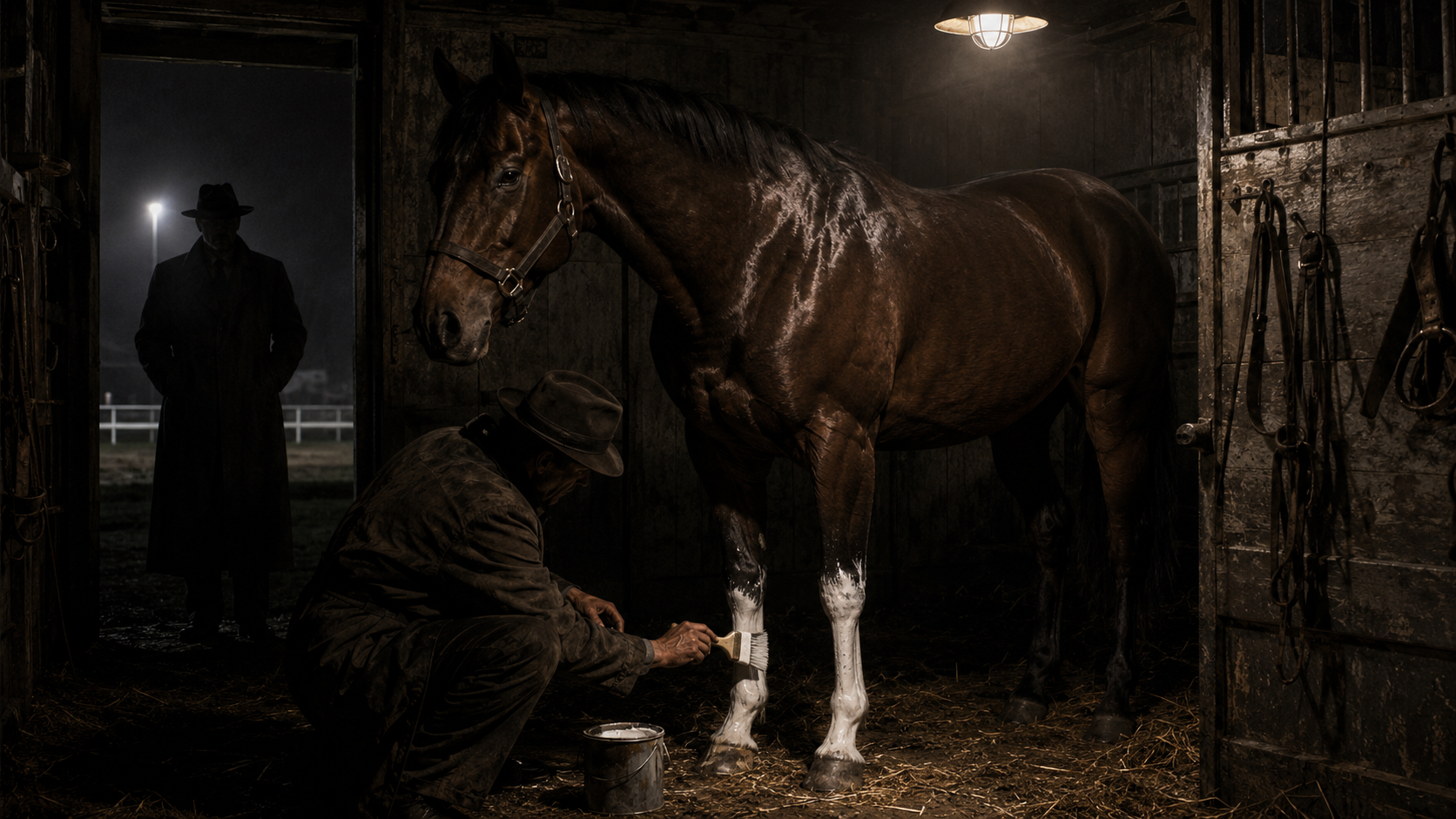
Fine Cotton was a dark brown horse with white markings on his hind legs. Bold Personality was a lighter bay without the same identifying markings. This was not the kind of discrepancy a different saddlecloth or a muddy afternoon could reasonably explain. It required a solution. The solution they settled on was hair dye. One member of the operation reportedly spent part of the night traveling between pharmacies to buy enough Clairol to change the color of a full-grown Thoroughbred. If you have ever looked closely at a racehorse, you already understand the scale of the problem. This was not touching up a gray temple before dinner. This was attempting to recolor hundreds of pounds of living, breathing horse before post time.
The first effort reportedly turned Bold Personality something closer to red than dark brown. Instead of producing a convincing Fine Cotton, the conspirators had apparently created a horse who looked as though he had lost an argument with a fire engine. More washing and more improvisation followed. Then came the white markings. Bold Personality did not have the white hind-leg features associated with Fine Cotton, so they applied paint or a similar whitening substance to approximate them. At this point, it is worth pausing to consider where the scheme stood. The original substitute had been injured. The replacement was the wrong color. The dye job had gone sideways. The leg markings were artificial. A considerable amount of money was expected to move. People in multiple places needed to know enough to place the bets, but not so many people that the entire racetrack learned what was coming. And still, they went forward.
Never underestimate the ability of people who believe they are close to a score to convince themselves that the obvious problems are somebody else’s problem.
Fine Cotton opened at approximately 33-1. For an ordinary horse with uninspiring recent form, those odds were not especially surprising. What happened next was. Money began appearing on Fine Cotton at Eagle Farm and beyond. Bets were placed with bookmakers in other locations, including Sydney. The price collapsed. By post time, the horse who had begun as a 33-1 outsider was approximately 7-2. That is not a subtle move. Gamblers understand the difference between a horse taking some informed money and a market being hit by people who appear to know something materially different from everyone else. Horses get bet for legitimate reasons all the time. A stable likes its chances. A horse trained better than the published form suggests. Equipment changes. Conditions suit. A sharp handicapper finds something the public overlooked. But when a horse with Fine Cotton’s profile attracts a national wave of support, people start asking questions. Apparently, some of them already had the answer.
By the time the field approached the start, whispers about a possible ring-in had begun circulating through sections of the betting community. Bookmakers noticed the move. Professional gamblers noticed the move. Information was traveling through the very network the conspirators were trying to exploit. The horse ran anyway. That may be the most important part of the entire story. The wrong horse did not merely appear at the races. The wrong horse appeared at the races while unusual betting activity was already producing suspicion, and he was still allowed to compete.
The betting market was beginning to understand there was a problem before the people responsible for protecting the race prevented one. If that sounds familiar, it should. The apprentice riding the horse, Gus Philpot, was not part of the conspiracy. He was later cleared. From his perspective, he was riding the horse he had been given to ride. He had no reason to know that the animal underneath him was not the horse listed in the program. Bold Personality did not simply gallop away from the field. That would have made the scheme look even more suspicious, although by then suspicion was already difficult to avoid. Instead, the race came down to a battle with Harbour Gold. The two horses fought through the stretch. Harbour Gold had the rail. Bold Personality, running as Fine Cotton, came at him from the outside. The margin at the finish was approximately a short half-head. An open-class horse substituted into a restricted novice race, a nationwide betting plunge, hair dye, painted markings, multiple conspirators and the possibility of a life-changing score, and the whole thing nearly came undone because the supposedly superior horse almost got beat. Horses humble everybody. If you spend enough time around this game, that part might be the least surprising detail of all.
There are no certainties once the gate opens. Not even when the horse you are betting is not the horse everybody else thinks he is. Bold Personality crossed the wire first, but whatever celebration the people behind the coup might have anticipated did not last. As the horse returned after the race, the disguise began attracting attention. The artificial markings were visible. Depending on the account, the paint was running or simply obvious enough to expose what had been done. People began shouting “ring-in.” The stewards intervened. Payment on the race was stopped. Questions were asked about Fine Cotton’s registration papers and identity. Haitana disappeared from the track rather than provide a satisfactory explanation. The winner was disqualified. Harbour Gold was awarded the race. The betting coup, at least in its most obvious form, had collapsed.
What followed was not nearly as funny as the hair dye. The investigations reached beyond the stable and into Australia’s bookmaking world. Among the most prominent names drawn into the affair were Bill Waterhouse and his son Robbie, members of one of the best-known bookmaking families in Australian racing. It is important to be precise here. Bill and Robbie Waterhouse were not convicted of physically substituting Bold Personality for Fine Cotton. Racing authorities found that they had prior knowledge of the scheme, and both were warned off racecourses. Their bookmaking privileges were revoked.
Knowing in advance that the horse entered under one name is not the horse who will actually run creates an entirely different relationship to the betting market. A bookmaker or bettor acting with that knowledge is not simply making a sharp assessment of the form. He possesses information that changes the identity of the proposition itself. Robbie Waterhouse acknowledged legal betting on Fine Cotton of approximately A$66,000. During a later family dispute, his brother David alleged that Bill and Robbie had placed approximately A$800,000 off the books. Robbie denied those allegations, and Bill maintained that he was not involved in the substitution. The larger number remains disputed and should not be treated as established fact. But the existence of substantial betting and the racing authorities’ findings about prior knowledge are not simply racetrack gossip.
A committee reviewing the matter concluded that the betting carried an overwhelming inference of centralized organization or direction involving Robbie Waterhouse. He was subsequently sentenced to eight months of periodic detention for making a false statement to a Racing Appeals Tribunal about his involvement in the betting. That is a long way from an amusing story about a badly painted horse.
The dye job may have been amateurish. The movement of money and information was something else entirely.
Gillespie, Haitana and Robert North ultimately served prison sentences. Other alleged participants, including John Dixon and Tom Di Luzio, faced criminal proceedings but were acquitted. Racing sanctions spread more widely than criminal convictions, another distinction worth keeping clear when discussing who was found responsible for what. Haitana did not quietly accept his role in the collapse. After disappearing, he appeared in an interview with Australia’s 60 Minutes and claimed he had been threatened. He connected those alleged threats to the earlier murder of Sydney trainer George Brown, saying a man displayed a gun and suggested that Haitana could meet the same fate.
Those claims added another layer of fear and underworld speculation, but any connection between the Fine Cotton affair and Brown’s murder should be treated as an allegation, not an established conclusion. The fact that Haitana believed, or said he believed, dangerous people were involved tells us something about the atmosphere surrounding the scheme. It does not establish that any particular person arranged a murder or ordered violence. Haitana was eventually arrested in South Australia and returned to Queensland. He served six months in jail and was banned from Australian racing for life.
The fallout also reached people whose involvement looked very different from that of the principal conspirators. Wendy Smith, a woman who had worked to establish herself in a racing industry that offered women relatively few opportunities at the time, became entangled on the periphery of the affair and ultimately lost her racing career. Decades later, she maintained that she had not knowingly participated in the fraud.
That is another familiar part of these stories. Not everyone standing near a conspiracy occupies the same place inside it. Some people organize. Some finance. Some carry messages. Some place bets. Some suspect more than they admit. Some get caught in the blast radius. And sometimes the person least equipped to recover is the one who pays a price that lasts the longest.
There was also a later theory that the whole operation may have contained a second con within the first.
According to that theory, some of the people involved may have recognized that the replacement horse was too obvious to pass inspection and proceeded anyway because there was another opportunity: obtain money from backers supposedly intended for betting, allow the scheme to fail, and quietly retain some portion of the funds while everyone else focused on the disqualification.
A double sting.
It is an intriguing possibility because it helps explain conduct that otherwise borders on irrational. Why proceed after Dashing Solitaire was injured? Why use a horse who looked so different? Why continue after the dye failed? Why take the risk of a national betting plunge on an animal carrying painted markings? Maybe greed overcame judgment. That happens often enough around racetracks. Maybe the participants believed they had protection, inside help or enough confusion to get away with it. Maybe the people financing the coup were not being told everything the people executing it knew. Or maybe some combination of all three.
The double-sting theory remains just that, a theory. It should not be confused with a proven finding. But any gambler who has spent enough time around ambitious betting operations understands why the possibility cannot be dismissed simply because it sounds cynical.
Sometimes the people trying to beat the game are also trying to beat the people standing beside them.
What makes Fine Cotton endure is not merely the absurdity. It is the number of different failures that had to line up before the horse ever reached the starting gate. Someone had to obtain the horses. Someone had to prepare them. Someone had to enter Fine Cotton. Someone had to transport Bold Personality. Someone had to attempt the disguise. Someone had to coordinate the betting. Someone had to communicate with people capable of placing money in different locations. And somewhere along the way, information about what was happening had to travel far enough for bookmakers and professional gamblers to begin whispering about a ring-in before the race was over. Yet the system designed to prevent the wrong horse from competing did not stop the race before the wrong horse competed. That is not simply a failure of identification. It is a failure of communication, oversight and institutional awareness.
And it is why laughing at the hair dye can become a convenient distraction. If the disguise had been better, if Dashing Solitaire had remained sound, if the betting had been distributed more carefully, if the substitute had possessed the right markings, or if the horse had won by a less suspicious margin, how much of the operation would we know about today? Probably very little.
That is the uncomfortable question behind almost every exposed racing scandal. We know about the one that failed because something went wrong. We do not automatically know how many others succeeded because nothing obvious did. Getting caught does not prove the safeguards worked. Sometimes it only proves the people trying to beat them made a mistake too large to hide.
Fine Cotton himself became the name attached to the scandal, although he was not the horse who ran and certainly was not the one responsible. Bold Personality was the impostor. Fine Cotton was the identity being borrowed. In a strange way, the wrong horse ended up carrying the notoriety for a race he never actually contested. There is something fitting about that too. Racing scandals have a way of attaching themselves to the most visible name while the deeper questions about access, money and responsibility remain less clearly resolved.
Which brings us back to Saratoga, Monmouth, the alleged Venezuelan betting coup and Marshall Gramm.
The modern allegations are not the Fine Cotton affair. The facts are different. The people are different. The mechanisms are different. Gramm has not been accused of orchestrating the alleged betting coup, and the matters should not be carelessly conflated. But the underlying integrity questions belong to the same family.
Who had information the public did not have? How did they obtain it? Who moved first? Who noticed? What did the wagering activity reveal? And why does racing so often appear to recognize the seriousness of the problem only after bettors begin asking questions?
In 1984, the advantage came from knowing that the horse in the race was not the horse listed in the program. Today, the advantage might come from knowing something about a horse’s condition, a confidential document, an unusual treatment, a coordinated wagering operation or another piece of information that materially changes how a race should be assessed. You do not necessarily need to repaint a horse anymore. You only need to make sure the people betting against you are looking at a different picture.
In Australia, they changed the horse and kept the name. In a modern betting market, change the information available to different people and you can create much the same imbalance without ever reaching for a can of paint.
The safeguards are better now, at least on paper. The technology is more sophisticated. Horse identification is more advanced. Betting can be monitored across platforms. Racing authorities have access to information that would have been unimaginable in 1984. And yet the question remains the same one it has always been. When the people trying to exploit the game know more than the people responsible for protecting it, what exactly are the safeguards safeguarding? Fine Cotton was supposed to be one horse and turned out to be another. Cinzano? That was a horse of a different color too. But that is a story for another day.